
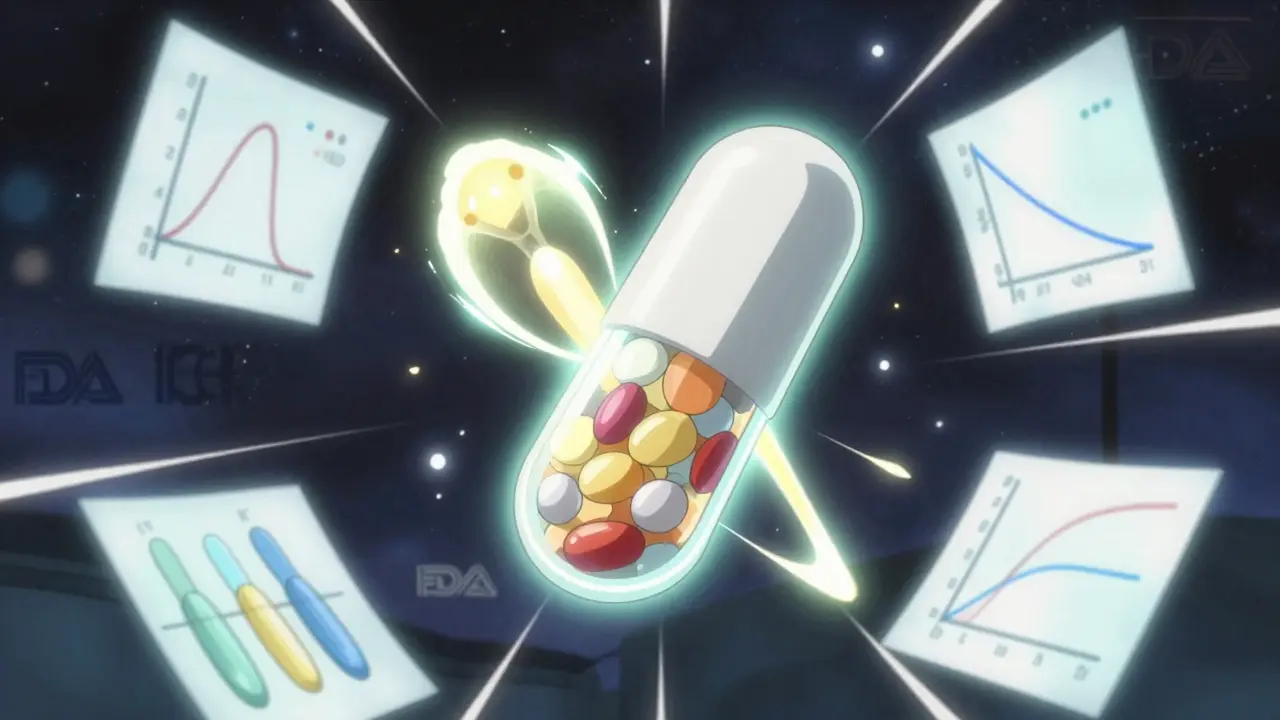
When you pick up a generic pill, you expect it to work just like the brand-name version. But how do manufacturers prove that? It’s not enough to copy the ingredients. The real challenge is matching how the drug behaves in your body-its absorption, release, and effectiveness. That’s where Quality by Design comes in. It’s not just a buzzword. It’s the new standard for making sure generic drugs are safe, consistent, and truly equivalent to the original.
What Is Quality by Design (QbD) and Why Does It Matter?
Quality by Design, or QbD, is a structured way to build quality into a drug from the very start-not by testing it at the end, but by understanding every part of how it’s made. The International Council for Harmonisation (ICH) defined it back in 2009, and since then, it’s become the gold standard. The FDA made it mandatory for all new generic drug applications in 2017. Before QbD, companies would follow a fixed recipe: mix for 15 minutes, compress at 12 kN, dry at 45°C. If the final product passed lab tests, it was approved. But what if a small change in humidity ruined the batch? That’s the problem QbD solves.
QbD asks: What are the critical things that affect how the drug works? How do changes in temperature, pressure, or ingredient mix impact performance? By answering these questions upfront, manufacturers can define a range of acceptable conditions-called a design space-where the product will still meet all quality standards. That means if a machine runs a little hotter one day, it’s not a crisis. It’s within the scientifically proven window.
The Five Pillars of QbD in Generic Development
Building a QbD-compliant generic drug isn’t random. It follows a clear, five-part framework.
1. Quality Target Product Profile (QTPP) - This is the blueprint. It lists exactly what the final product needs to do: dissolve at the right speed, contain the correct amount of active ingredient, stay stable for three years, and keep impurities below safe limits. For generics, the FDA requires at least 95% similarity to the reference drug in dissolution tests. No wiggle room.
2. Critical Quality Attributes (CQAs) - These are the measurable traits that directly affect safety and performance. For a tablet, that might be dissolution rate (must match the brand within an f2 similarity factor of 50 or higher), content uniformity (variation under 6% across all tablets), and impurity levels (following ICH Q3B limits). Most generic products have between 5 and 12 CQAs. Miss one, and the whole application risks rejection.
3. Critical Process Parameters (CPPs) - These are the knobs you turn during manufacturing. Things like granulation moisture (1.5-3.0%), compression force (10-15 kN), drying temperature (40-50°C). QbD doesn’t fix these to single values. Instead, it uses experiments to find the working range where CQAs stay in control.
4. Design Space - This is where QbD gets powerful. The design space is the multidimensional zone where all CPPs can vary, and the product still meets every CQA. The FDA accepts design spaces built on data from 100+ simulated batches. Once approved, manufacturers can adjust parameters within this space without submitting a new application. That saves time, money, and reduces supply chain disruptions.
5. Control Strategy - This is how you keep things stable. It includes in-process checks, final testing, and, increasingly, real-time monitoring. Eighty-seven percent of QbD users now use Process Analytical Technology (PAT)-like near-infrared sensors-to measure moisture or blend uniformity as the tablet is being made. This cuts end-product testing by 35-60%, making production faster and more reliable.
QbD vs. Traditional Methods: The Real Difference
Traditional generic development was like baking a cake with one recipe: 2 cups flour, 1 cup sugar, bake 30 minutes at 350°F. If it burned, you blamed the oven. If it was too dry, you blamed the flour. You didn’t understand why.
QbD is like being a food scientist. You test how flour protein content affects texture. You check how oven temperature impacts browning. You map out the exact conditions where the cake turns out perfect every time. That’s what QbD does for pills.
The numbers don’t lie. According to the FDA’s Office of Generic Drugs, applications using QbD get approved in 9.2 months on average-almost five months faster than traditional submissions. They also get 31% fewer Complete Response Letters (CRLs), which are official rejections asking for more data. One manufacturer, Hikma Pharmaceuticals, reported their post-approval quality issues dropped from 14 per year to just 2 after switching to QbD.
But it’s not all smooth sailing. QbD adds 4-8 months to development time and increases upfront costs by 25-40%. A single DoE study can cost $200,000-$500,000. That’s why some experts warn against over-engineering simple products. For a basic immediate-release tablet with a well-known formulation, spending $450,000 on 50 experimental runs might be unnecessary.

Who’s Using QbD-and Who’s Struggling?
QbD adoption is skyrocketing. In 2018, only 38% of new generic applications included QbD. By 2022, that jumped to 74%. For complex products-like extended-release tablets, inhalers, or transdermal patches-it’s nearly universal: 92% use QbD. Why? Because traditional methods often fail to prove bioequivalence for these drugs. You can’t just match the pill’s appearance. You need to prove it releases the drug the same way in the body. QbD makes that possible.
But not everyone succeeds. The European Medicines Agency found that 63% of QbD failures stem from poor understanding of how the formulation actually works. For example, some companies try to mimic a brand’s dissolution curve without knowing why it behaves that way. That’s like copying a song by humming it-you might get the tune, but you miss the rhythm.
Indian manufacturers are catching up, with 68% adoption, but cost remains a barrier. The top 10 Indian generics companies spent $227 million on QbD capabilities in 2022. Meanwhile, U.S. and EU firms are at 89%. The WHO now includes QbD in its prequalification program, meaning global suppliers must meet these standards to sell to low-income countries.
Real-World Wins and Smart Shortcuts
Some companies are finding smarter ways to do QbD without breaking the bank.
One best practice: use the reference drug’s data. Instead of re-testing everything, advanced analytical tools can characterize the brand-name product’s structure, porosity, and dissolution behavior. This cuts development time by 30%. Another shortcut: bracketing. If you’re making 5 strengths of the same drug, you don’t need to test all of them. Test the highest and lowest, and use science to prove the middle ones behave the same. That reduces studies by 45%.
Then there’s continuous manufacturing. Teva’s 2022 QbD project for levothyroxine used a continuous production line instead of batch processing. The result? 28% higher batch consistency. The FDA approved it under its Emerging Technology Program-and gave it a 100% approval rate.
One of the biggest benefits? Flexibility. Mylan (now Viatris) used its QbD design space for simvastatin to make 11 process changes during the pandemic without waiting for FDA approval. They kept supply flowing. That’s not luck. That’s science.

What You Need to Get Started
Implementing QbD isn’t just about buying new machines. It’s about changing how your team thinks.
- Training: Scientists need 80-120 hours of training in risk management (ICH Q9) and Design of Experiments (DoE). The FDA offers free online modules. Over 1,200 industry professionals completed them in 2022.
- Tools: You’ll need PAT equipment (NIR, Raman spectroscopy), which costs at least $500,000. Software like MODDE Pro for multivariate analysis runs about $15,000 per user per year.
- Time: For a simple tablet, expect 6-9 months. For a complex product like an inhaler, plan for 12-18 months.
The FDA’s QbD Pilot Program has processed 87 submissions with a 92% first-cycle approval rate-compared to 78% for traditional ones. That’s the proof it works.
The Future of QbD: Where It’s Headed
QbD isn’t slowing down. The FDA’s new ICH Q14 guideline (effective December 2023) requires more robust analytical data but rewards it with faster validation-up to 40% quicker for QbD-aligned methods. The agency’s 2024-2026 plan targets 3D-printed drugs and biologic follow-ons next.
McKinsey predicts that by 2027, 95% of new generic approvals will include QbD. The trend is clear: regulators want science, not guesswork. Companies that invest in QbD aren’t just complying-they’re gaining agility, reducing costs over time, and building trust.
But here’s the catch: QbD must fit the product. For a $10-a-year generic, spending $1 million on development isn’t sustainable. The Generic Pharmaceutical Association warns that for low-revenue products, development costs should stay under 15% of lifetime sales. Smart QbD means knowing when to go deep-and when to keep it simple.
Quality by Design isn’t about perfection. It’s about control. About understanding. About building confidence-not just in the pill, but in the entire system that brings it to you.
Is QbD mandatory for all generic drugs?
Yes, since October 1, 2017, the U.S. FDA has required QbD elements in all Abbreviated New Drug Applications (ANDAs). While not every single detail needs to be QbD-style, the core components-QTPP, CQAs, design space, and control strategy-are now expected in every submission. Other regulators like the EMA and PMDA have similar requirements, especially for complex generics.
Does QbD guarantee bioequivalence?
Not directly. QbD doesn’t replace bioequivalence studies-it supports them. It ensures the drug’s physical and chemical properties (dissolution, particle size, impurity profile) are tightly controlled so that when you do run a clinical bioequivalence study, the results are reliable and reproducible. In many cases, especially for simple immediate-release products, a well-designed QbD approach can eliminate the need for clinical trials by proving equivalence through in vitro testing alone.
Can small generic manufacturers afford QbD?
It’s challenging, but possible. The upfront investment is high-$500,000+ for equipment and months of training. But many small firms partner with CMOs (contract manufacturing organizations) that already have QbD infrastructure. Others start with one product, use risk-based bracketing to reduce testing, and leverage FDA’s free training resources. For high-volume, low-margin products, QbD may not make sense-but for anything with complex release profiles or high regulatory risk, it’s often the only viable path.
What’s the biggest mistake companies make with QbD?
Treating QbD as a checklist instead of a science. Many companies run DoE studies just to check a box, without understanding the underlying mechanisms-like why a change in granulation moisture affects dissolution. Without mechanistic insight, the design space is fragile. When a raw material supplier changes, or humidity shifts, the product fails. True QbD means knowing the ‘why,’ not just the ‘what.’
How does QbD affect drug pricing?
It doesn’t raise prices-it lowers long-term costs. While QbD increases upfront development expenses, it reduces post-approval changes, quality failures, and regulatory delays. Companies save an estimated $1.2-2.8 million per product annually in submission fees and manufacturing disruptions. For complex generics, it also opens the door to higher-value markets. The real cost isn’t in the science-it’s in avoiding the cost of failure.

Pankaj Singh
January 13, 2026 AT 06:37QbD? More like Quality by Budget-Depleted. Indian manufacturers are being strangled by this over-engineered nonsense. You spend half a million on NIR sensors just to make a $0.02 pill? The FDA doesn't care if you understand the 'why'-they just want another checkbox. We've been making generic tablets since the 80s without all this jazz. Now they want us to be pharmaceutical scientists on a shoestring. Wake up.
jefferson fernandes
January 13, 2026 AT 23:08Let’s be clear: QbD isn’t optional-it’s essential. And yes, it’s expensive. But let’s also be honest: the old way? It was a crapshoot. I’ve seen batches fail because someone used flour from a different supplier and didn’t test the protein content. QbD doesn’t just prevent failures-it prevents lawsuits, recalls, and deaths. Yes, it costs more upfront. But when your product doesn’t get a CRL, and your plant doesn’t shut down for six months? You’re saving millions. This isn’t luxury-it’s liability management.
Trevor Davis
January 14, 2026 AT 10:46Look, I get it. The FDA’s pushing this hard. And honestly? I’m tired of the jargon. But I’ve worked in both worlds-the old ‘mix, compress, pray’ method and the new QbD chaos. The difference? One makes you sleep at night. The other makes you check the news every morning wondering if your batch got pulled. I don’t care if it’s ‘over-engineered’-if it keeps people from getting sick because their generic didn’t dissolve right, then it’s worth every penny. And yes, I cried when my first QbD submission got approved in 8 months. No joke.
Acacia Hendrix
January 14, 2026 AT 21:24It’s fascinating how the industry still conflates compliance with innovation. QbD, as codified under ICH Q10 and Q11, represents a paradigmatic shift from empirical control to mechanistic understanding-leveraging multivariate analysis and risk-based design spaces to operationalize quality as a dynamic, system-level property. The fact that 63% of failures stem from superficial modeling of CQAs speaks to a fundamental epistemological deficit in legacy manufacturing culture. Without a systems-thinking approach to CPP-CQA mapping, one is merely performing pharmaceutical ritualism.
Rosalee Vanness
January 16, 2026 AT 13:16I just want to say-this is the kind of work that makes me proud to be in this field. I used to think generics were just cheap copies. But reading this? It’s like watching someone rebuild a heart with precision tools instead of duct tape. The patience, the science, the sheer will to get it right-especially for people who can’t afford brand-name drugs-it’s not just regulatory compliance. It’s dignity. And yeah, it’s expensive. But imagine if we didn’t do this? Imagine if someone took a pill that didn’t work because we cut corners? I can’t sleep knowing that could happen. So yes, invest. Train. Build. We owe it to the people who trust us with their health.
Scottie Baker
January 17, 2026 AT 14:47QbD is a scam. Full stop. The FDA doesn’t care about your design space-they care that you paid your consultants. I’ve seen companies spend $500k on DoE studies and then use the exact same recipe as the brand because they didn’t understand the data. It’s theater. The real winners? The ones who game the system. Submit a pretty report with fancy graphs, get approved, then quietly revert to the old way. The FDA doesn’t audit your plant every day. So why waste money? Save it for your next yacht.
Anny Kaettano
January 18, 2026 AT 18:40Hey everyone-I just wanted to say thank you to the people who are doing this right. I know it’s hard. I know it’s expensive. I know sometimes you feel like you’re shouting into the void. But you’re not. Every time you nail a dissolution profile, every time you catch a variation before it becomes a problem, you’re saving someone’s life. I’ve seen patients on generics who can’t afford anything else. And when their medicine works? It’s not just science-it’s hope. Keep going. You’re making a difference.
Jesse Ibarra
January 19, 2026 AT 20:09Let’s be brutally honest: QbD is just corporate greed in a lab coat. Big Pharma invented this to kill small generic manufacturers. They want to monopolize the market by making compliance so expensive that only 5 companies can afford it. And now the FDA is their enforcer. Meanwhile, patients are paying more because competition is being crushed. This isn’t science-it’s a cartel. And you’re all just playing along.
Randall Little
January 21, 2026 AT 11:56So… you’re telling me we spent 20 years making pills like cookies, and now we’re supposed to be food scientists? Interesting. So if I understand correctly, the FDA now requires us to understand the chemistry of a tablet… but still lets companies sell insulin for $300 a vial? The real tragedy isn’t QbD-it’s that we’re using this brilliant, science-driven framework to regulate a broken system. The pill works? Great. But why is the system so broken that we need 100+ experimental batches just to prove it?