
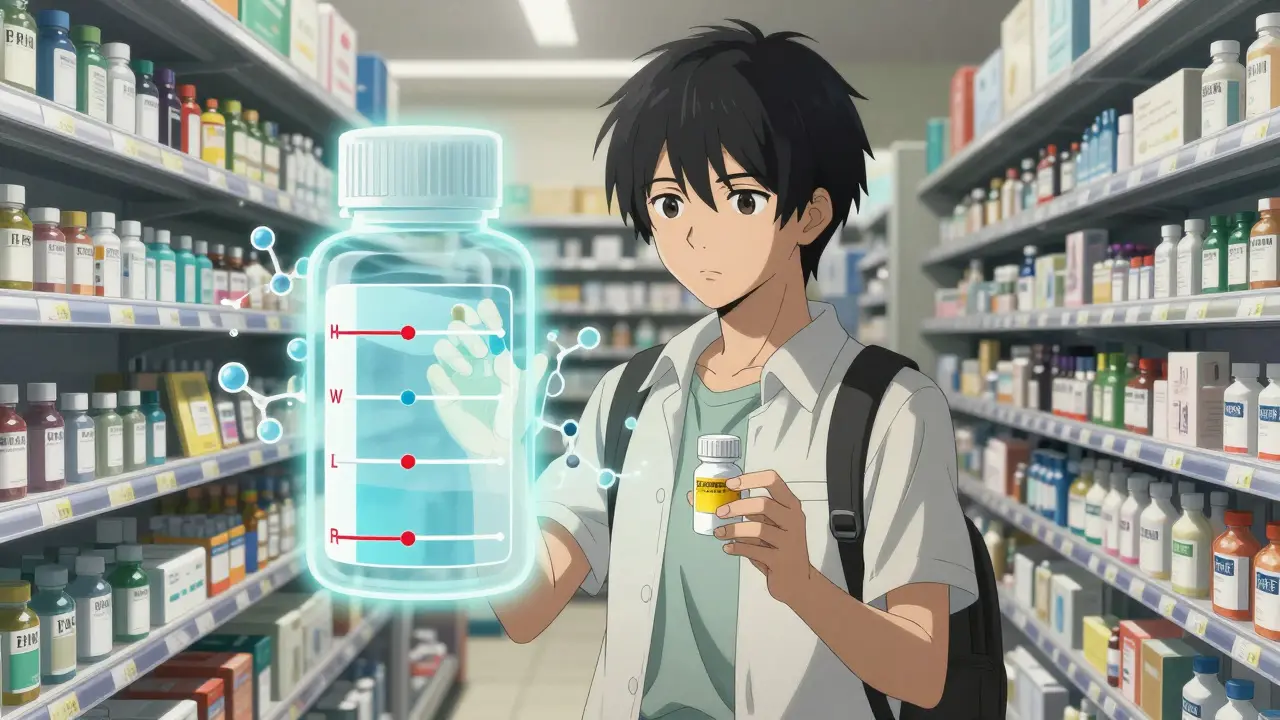
When you pick up a prescription at the pharmacy and see a different name on the bottle than what your doctor wrote, it’s natural to wonder: Is this the same thing? The answer lies in a quiet but powerful process called bioequivalence testing - and it’s the reason millions of people can safely take generic drugs every day without risking their health.
What Bioequivalence Really Means
Bioequivalence isn’t just a fancy term. It’s a scientific guarantee. It means that a generic drug delivers the same amount of active ingredient into your bloodstream at the same speed as the brand-name version. No more, no less. This isn’t about looks, taste, or packaging - it’s about what happens inside your body.
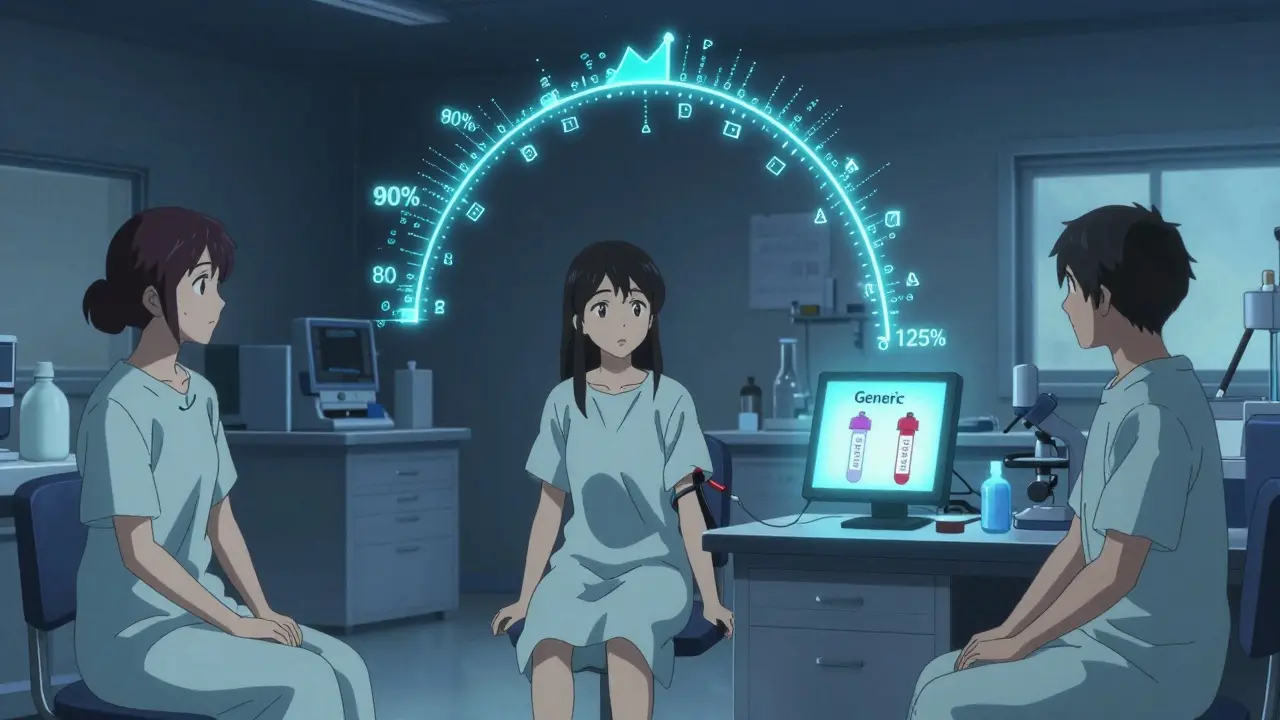
The standard? The 90% confidence interval for two key measurements - AUC (total drug exposure) and Cmax (peak concentration) - must fall between 80% and 125% of the brand-name drug. In plain terms: if the brand drug gets 100 units of medicine into your blood, the generic must get between 80 and 125 units. That’s not a wide gap. It’s a tight, science-backed window designed to ensure your treatment works the same way.
For drugs with a narrow therapeutic index - like warfarin, levothyroxine, or cyclosporine - the rules get even stricter. The range narrows to 90-111%. Why? Because even tiny changes in dose can lead to serious side effects or treatment failure. These aren’t theoretical concerns. Real patients have been hospitalized when bioequivalence wasn’t properly enforced.
How They Test It
Bioequivalence isn’t guessed at. It’s measured. Most studies are done in healthy volunteers - people aged 18-55, with normal liver and kidney function, and a BMI between 18.5 and 30. They take a single dose of either the brand or generic drug, then have their blood drawn every 15 to 30 minutes over 24 to 72 hours. The data is analyzed using complex statistical models to confirm the drug’s absorption pattern matches.
For some drugs, like those taken with food, studies are done in both fasting and fed states. Why? Because food can change how quickly a drug is absorbed. If the brand drug is meant to be taken with a meal, the generic must prove it behaves the same way. In Japan, they test only in the fasted state - even if the brand is taken with food - if the drug’s levels are measurable. That’s one of many global differences that make developing generics a global puzzle.
For drugs with active metabolites - like losartan, where the metabolite EXP-3174 does most of the work - both the parent drug and the metabolite must be measured. Missing one means missing half the story.
Why It Protects You
Here’s the real question: does this testing actually keep people safe? The data says yes.
In 2020, generic drugs saved the U.S. healthcare system $313 billion. They make up 90% of prescriptions but cost only 23% of what brand drugs do. That’s not just about money - it’s about access. Without generics, many people simply wouldn’t be able to afford their meds.
But safety? The FDA’s Adverse Event Reporting System (FAERS) shows only 0.07% of all adverse events linked to generic drugs from 2020-2023 were tied to bioequivalence failures. Compare that to 2.3% for brand-name drugs. Why? Because generics are held to the same quality standards. They must use the same active ingredients, meet the same purity rules, and be manufactured in facilities inspected to the same level.
Patients notice it too. A 2022 survey by the National Community Pharmacists Association found 87% of users said generic drugs worked just as well as brand-name ones. On Drugs.com, generic levothyroxine - a drug once plagued by inconsistent absorption - now has a 6.5/10 rating, with 58% of reviewers saying it works the same as the brand. That’s not luck. That’s science.
Where the System Still Has Gaps
Not every drug is easy to test. Topical creams, inhalers, and eye drops don’t enter the bloodstream the same way pills do. You can’t just measure blood levels. For these, regulators now use a mix of lab tests, imaging, and clinical outcomes. The FDA’s 2022 initiative on complex generics is trying to fix this. But progress is slow.
Some experts still worry. Dr. Kenneth C. Falci from the University of Utah points out that even within the 80-125% range, there’s room for variation. For someone on a tight dose of seizure medication, a 125% exposure might push them into toxicity. That’s why regulators have special rules for high-variability drugs - widening the range to 75-133% but adding a constraint on the average ratio to prevent wild swings.
And then there’s the human factor. Reddit threads like “Generic Switch Caused Problems” have hundreds of comments from people who felt worse after switching. But pharmacists who reply to those threads are quick to note: these are rarely bioequivalence failures. They’re more often about placebo effects, changes in inactive ingredients (like dyes or fillers), or psychological resistance to generics. The FDA doesn’t recall products based on anecdotes. They look at data - and they haven’t found a pattern.

What’s Next for Bioequivalence
The future is getting smarter. Instead of always running human trials, researchers are using computer models - called PBPK (physiologically-based pharmacokinetic) models - to predict how a drug will behave. In 2018, the FDA accepted 3 PBPK submissions for generics. By 2022, that jumped to 17. This cuts costs, speeds up approvals, and reduces the number of healthy volunteers needed.
Artificial intelligence is also being tested. One pilot project in Europe used machine learning to predict bioequivalence based on how a drug dissolves in a lab setting. If it dissolves the same way as the brand, the model predicts it will behave the same in the body. It’s not ready to replace human trials yet - but it might cut them in half.
Regulators are also working to harmonize rules. The International Pharmaceutical Regulators Programme now includes 16 countries, from Australia to Switzerland, trying to align their testing standards. That’s huge. Right now, a generic company might need to run five different studies to sell in five markets. Harmonization could cut that cost - and get life-saving drugs to more people faster.
What You Should Know
If you’re prescribed a generic drug, you’re not getting second-best. You’re getting the same medicine, tested to the same standard, made in the same type of facility, and monitored just as closely.
Don’t be fooled by myths. Generics don’t have weaker ingredients. They don’t take longer to work. They don’t cause more side effects. The science says otherwise.
And if you do feel different after switching - talk to your pharmacist. It might be the filler. It might be your body adjusting. But it’s almost never because the drug failed bioequivalence testing.
The system isn’t perfect. But it’s the best we have. And it works. Every day, millions of people - in Sydney, in Chicago, in Nairobi - rely on this testing to stay alive, to manage chronic illness, to afford their treatment. Bioequivalence isn’t just a lab procedure. It’s a promise: that your medicine will do what it’s supposed to do - safely, reliably, and without costing you a fortune.
Are generic drugs as safe as brand-name drugs?
Yes. Generic drugs must meet the same strict standards for identity, strength, purity, and performance as brand-name drugs. They undergo bioequivalence testing to prove they deliver the same amount of active ingredient into your bloodstream at the same rate. Regulatory agencies like the FDA and EMA require this before approval. Post-market monitoring also shows that adverse events from generics are rare and not linked to bioequivalence failures.
Why do some people say generics don’t work as well?
Some people report feeling different after switching - but this rarely means the drug failed testing. Differences can come from inactive ingredients (like dyes or fillers), psychological expectations, or changes in routine. For drugs with a narrow therapeutic index - like levothyroxine - even small changes can cause noticeable effects, which is why those generics are held to tighter standards. If you feel off after switching, talk to your pharmacist. It’s rarely a bioequivalence issue.
Do bioequivalence studies always use healthy volunteers?
Most do - because it’s safer and more controlled. But for drugs where stopping treatment could be dangerous - like blood thinners or epilepsy meds - studies are done in actual patients. In those cases, researchers monitor closely and use multiple-dose designs to ensure safety. The goal is always to reflect real-world use without putting people at risk.
How long does bioequivalence testing take?
A typical bioequivalence study takes 12 to 18 months from design to approval. It includes recruiting volunteers, conducting trials, analyzing data, and submitting results to regulators. Costs range from $1 million to $2 million per formulation. For complex drugs - like inhalers or topical creams - it can take longer and cost more because additional testing is needed.
Are bioequivalence standards the same everywhere?
Most major regulators - including the FDA, EMA, Health Canada, and TGA in Australia - use the 80-125% range for standard drugs. But there are differences. Japan requires fasted-state testing even if the brand is taken with food. Brazil mandates extra medical checks. Some countries are still developing their frameworks. The goal of global harmonization is to reduce these gaps - but they still exist today.


Spenser Bickett
February 25, 2026 AT 14:13Christopher Wiedenhaupt
February 27, 2026 AT 13:52John Smith
February 27, 2026 AT 15:19Brooke Exley
February 28, 2026 AT 21:43Bhaskar Anand
March 2, 2026 AT 17:01William James
March 3, 2026 AT 07:56David McKie
March 4, 2026 AT 01:05Southern Indiana Paleontology Institute
March 4, 2026 AT 22:25Anil bhardwaj
March 6, 2026 AT 14:48lela izzani
March 7, 2026 AT 06:54Dinesh Dawn
March 7, 2026 AT 21:07