
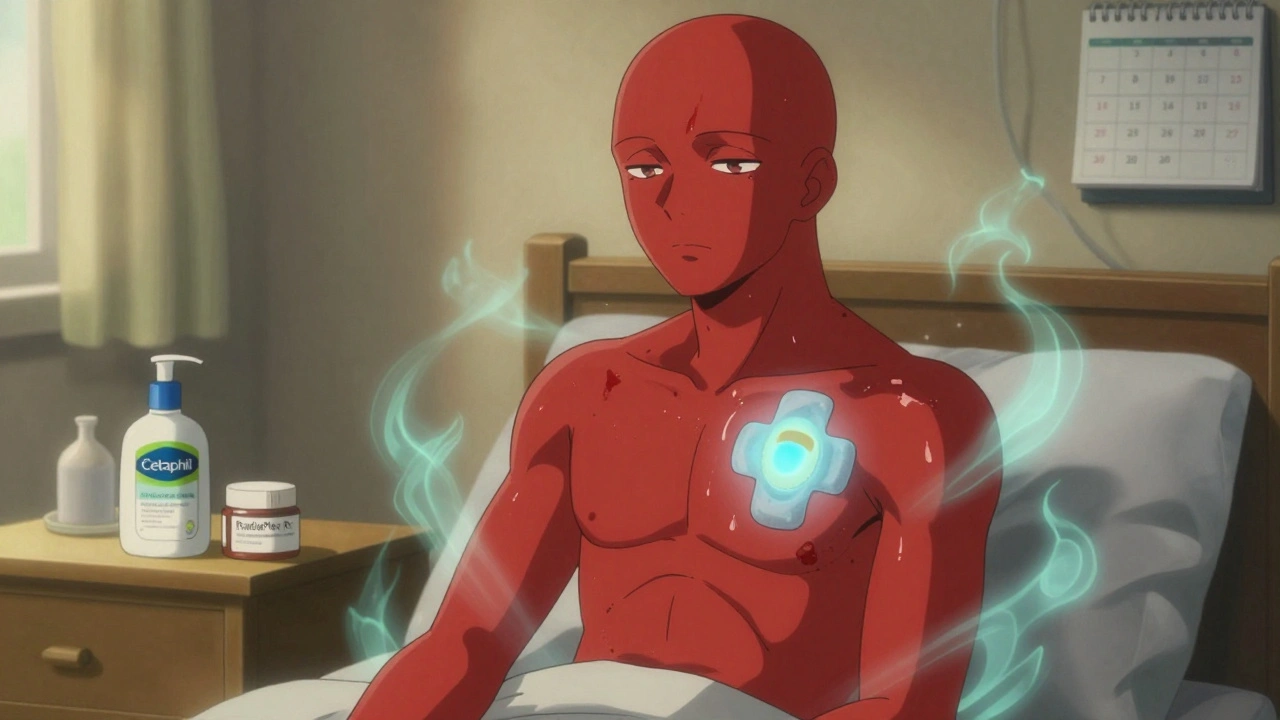
When you’re undergoing radiation therapy for cancer, the goal is clear: destroy cancer cells. But what no one tells you upfront is how much your body will change along the way. Two of the most common, most disruptive side effects are radiation side effects on your skin and overwhelming fatigue. They don’t show up on scans, but they shape your days more than anything else.
Skin Reactions: What to Expect and How to Handle It
Your skin is the first line of defense-and the first to react. Around day 7 to 10 of treatment, you might notice redness, warmth, or tightness in the treated area. It looks like a sunburn, but it’s deeper. By week 3 or 4, dry flaking starts. If you’re getting radiation to your neck, chest, or breast, you could develop moist skin-oozing, blistering, even painful. About 1 in 4 patients hit this stage. It’s not rare. It’s expected. The key? Don’t wait until it hurts. Start caring for your skin before the damage shows. Use a gentle, fragrance-free cleanser like Cetaphil. Wash with lukewarm water-no hot showers. Pat, don’t rub. Within three minutes of washing, apply a moisturizer with ceramides. These help rebuild your skin’s barrier. Avoid anything with alcohol, perfume, or witch hazel. They’ll sting. A lot. If your skin breaks open, don’t panic. Hydrogel dressings are now the gold standard for moist desquamation. They keep the area cool, clean, and moist, speeding healing by up to 32%. Some patients swear by Cavilon No Sting Barrier Film-it’s like a clear shield that prevents further breakdown. Your radiation nurse should give you a sample before your second week. If they don’t, ask. You’re not being pushy; you’re being smart. Late effects are real too. After treatment ends, some skin stays darker, thinner, or tighter. Tiny red veins (telangiectasias) might appear in 30-50% of people after five years. Hair loss in the treated area is common. If you had radiation to your scalp, expect 15-20% of hair to never grow back if you got over 50 Gy. But 50% regrowth usually happens by 2-3 months after treatment. That’s progress.Fatigue: It’s Not Just Being Tired
Fatigue from radiation isn’t like the kind you get from a long day. It’s deeper. It’s not fixed by sleep. It’s the kind where you lie down after brushing your teeth and still feel like you ran a marathon. About 8 out of 10 radiation patients experience this. It starts around week 2-3, climbs steadily, and peaks at week 5-6. If you’re getting radiation to your pelvis or abdomen, it’s worse. Your PROMIS fatigue score-a standard measure-can hit 65 out of 100. That’s severe. Most people think fatigue stays flat. It doesn’t. It creeps up. One patient on a cancer forum said, “I thought I’d be tired on Monday, okay by Friday. Instead, Friday was worse than Monday. And Saturday? I couldn’t get off the couch.” The good news? Movement helps. Not intense workouts. Just walking. Thirty minutes a day, five days a week. That’s it. Studies show this cuts fatigue by 25-30%. Resistance training twice a week helps even more. One breast cancer patient kept her energy up by walking daily and lifting light weights. Her fatigue score was 22 points lower than others who didn’t move. Sleep matters too. Don’t nap longer than 20-30 minutes. Go to bed and wake up at the same time every day-even weekends. Your body needs rhythm. If you’re still exhausted, talk to your doctor. Modafinil, a medication used for excessive sleepiness, helped one patient drop their fatigue score from 72 to 58 in two weeks. It’s not for everyone, but it’s an option.Recovery: What Happens After Treatment Ends
When your last session is done, you might think, “I’m free.” But your body isn’t done healing. Skin reactions usually fade in 2-4 weeks. But fatigue? That can linger for months. Some people say it takes 6-12 months to feel like themselves again. Fibrosis-thickening and stiffening of tissue-is a late effect. It’s rare, but it happens in 5-10% of head and neck patients. Physical therapy can help. Stretching, massage, and breathing exercises keep things flexible. Don’t wait until it’s painful. Start early. Your skin might always look different. It might be more sensitive to the sun. Always use SPF 30+ on treated areas, even in winter. And don’t assume your skin will bounce back like it did after a sunburn. Radiation changes the structure. Treat it gently, long after treatment ends.
What Works Better: Modern Techniques
Not all radiation is the same. If you’re eligible, IMRT (Intensity-Modulated Radiation Therapy) or proton therapy can cut skin damage by 25-40% compared to older methods. They target the tumor more precisely, sparing healthy skin. But access is limited. There are only 42 proton centers in the U.S. And cost? Insurance doesn’t always cover it. Still, ask your oncologist: “Is there a way to reduce skin exposure?” Even small changes in positioning or shielding can make a difference. You’re not asking for luxury-you’re asking for better quality of life.What Doesn’t Work
Avoid topical steroids unless your doctor prescribes them. Studies show they don’t prevent radiation dermatitis. Aloe vera? It might feel soothing, but it doesn’t speed healing. In fact, some aloe products have alcohol or additives that irritate. Stick to products backed by clinical trials: Biafine, RadiaPlex Rx, hydrogel dressings. These are the ones oncology teams actually use. Don’t ignore fatigue. Saying “just rest more” isn’t enough. You need structure: movement, sleep rules, and sometimes medication. And don’t feel guilty for needing help. This isn’t weakness. It’s biology.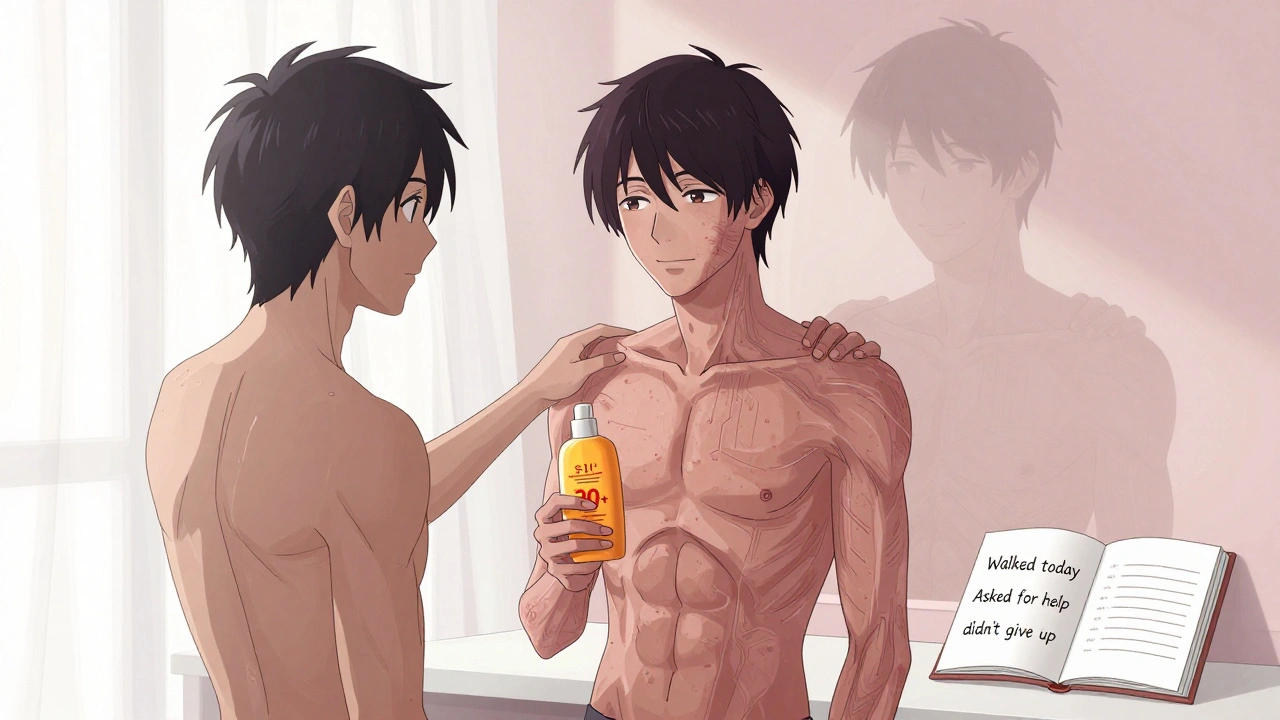
What’s New in 2025
Science is catching up. In 2023, researchers found 12 genetic markers that predict who’s likely to get severe skin reactions. If you’re tested, your care team can adjust your skin care plan before you even start. That’s personalized medicine. Apps like Mindstrong Health’s ‘Vitality’ are now FDA-cleared. They track your energy levels daily and suggest small, doable changes-like walking 10 minutes after lunch. In trials, users saw a 28% drop in fatigue scores. A new topical cream, ON 01910.Na, is in phase III trials. Early results show it cuts moderate-to-severe skin reactions by 40%. It could be available by late 2025.Real Talk: What Patients Wish They Knew
One patient said: “I was told to ‘keep the area clean.’ That’s it. No product recommendations. No timeline. I had no idea my skin would peel like a sunburn. I thought I’d be told what to do.” Another: “I thought fatigue would be worse at the beginning. It wasn’t. It got worse. Week 6 was the worst. No one warned me.” The biggest mistake? Waiting. Waiting for the skin to crack. Waiting for the fatigue to crush you. The best defense is a proactive plan. Ask for a skin care guide before your first session. Schedule a fatigue management consult with a nurse. Write down your questions. Bring someone with you to appointments. You’re not just fighting cancer. You’re fighting side effects too. And you don’t have to do it alone.How long do radiation skin side effects last?
Acute skin reactions like redness and peeling usually clear up 2-4 weeks after treatment ends. But some changes, like darker skin, dryness, or visible blood vessels, can last for years. Late effects like fibrosis or permanent hair loss may take 6-12 months to stabilize. Skin care doesn’t stop when radiation does-it just changes.
Can I use lotion during radiation therapy?
Yes, but not just any lotion. Use fragrance-free, alcohol-free moisturizers with ceramides or hyaluronic acid. Brands like Cetaphil, Eucerin, or RadiaPlex Rx are recommended. Apply gently after bathing, within 3 minutes. Avoid thick ointments like petroleum jelly before treatment-they can increase skin dose. Always check with your radiation team before using anything new.
Why does radiation make you so tired?
Radiation damages healthy cells along with cancer cells. Your body uses energy to repair that damage, which drains your reserves. Inflammation, stress hormones, and disrupted sleep also contribute. Fatigue builds over time-it’s not just from one session. The more area treated (like your whole pelvis), the worse it gets. It’s your body’s way of saying it’s working hard.
Is it safe to exercise during radiation therapy?
Yes, and it’s strongly recommended. Moderate exercise-like walking 30 minutes five days a week-reduces fatigue by 25-30%. Light strength training twice a week helps too. Avoid overexertion, but don’t stay still. Movement improves blood flow, reduces inflammation, and boosts mood. Talk to your care team about what’s safe for your treatment area.
What products are proven to help with radiation skin care?
Products with clinical backing include Biafine, RadiaPlex Rx, and hydrogel dressings like Mepilex Border. Silver sulfadiazine is used for broken skin. Cavilon No Sting Barrier Film prevents further breakdown. Avoid aloe vera, coconut oil, and homemade remedies unless approved by your oncology nurse. Insurance often covers approved products-ask your provider.
When should I call my doctor about radiation side effects?
Call if your skin becomes open, weeping, or very painful; if you develop a fever over 100.4°F; if fatigue prevents you from getting out of bed for more than 24 hours; or if you notice swelling, numbness, or new pain in the treated area. These could signal infection, severe reaction, or late damage. Don’t wait. Early intervention prevents bigger problems.
Recovery isn’t a single moment. It’s a series of small choices: applying moisturizer, taking a walk, asking for help. You’re not just surviving treatment-you’re rebuilding. And every step, no matter how small, counts.

Gene Linetsky
December 3, 2025 AT 14:34So let me get this straight-you’re telling me a $200 cream is better than aloe vera from my cousin’s garden? Meanwhile, the FDA just approved a new cream that’s still in trials and you’re acting like it’s gospel. Wake up. Big Pharma’s been selling ‘miracle’ lotions since the 80s. I’ve seen 3 patients go broke on ‘clinical-grade’ gels while their oncologist just told them to use Vaseline. You’re not healing skin-you’re feeding a marketing machine.
Makenzie Keely
December 4, 2025 AT 12:56Wait-did anyone else notice how the post mentioned ‘hydrogel dressings’ but didn’t specify brand names? I’ve been using Mepilex Border since my second week, and it’s the only thing that kept me from screaming through every shower. Also-Cavilon No Sting Barrier Film? YES. My nurse gave me a sample on day 5, and I cried because no one had ever told me it existed. Please, if you’re reading this and you’re starting radiation: ask for the skin care protocol BEFORE your first session. Don’t wait until your skin is peeling like a bad sunburn. You deserve better than guesswork.
Francine Phillips
December 6, 2025 AT 01:24Been through it. Week 6 was the worst. Couldn’t lift my arm. Couldn’t sleep. Didn’t even try to walk. Just stared at the ceiling. No one talks about that part. The silence after the treatment ends. Like the world forgot you were still broken.
Katherine Gianelli
December 6, 2025 AT 22:04Francine-you’re not alone. I remember lying on my couch thinking I’d never feel light again. But slowly-so slowly-I started walking to the mailbox. Then to the end of the driveway. Then around the block. It didn’t fix me. But it reminded me I was still here. And that mattered more than any cream or pill. You’re not lazy. You’re healing. One step at a time.
Chloe Madison
December 7, 2025 AT 15:20For those asking about exercise: I lifted 3-pound dumbbells every morning while watching morning news. Not because I wanted to be strong-but because I needed to feel like I was doing something. Not just waiting. Not just surviving. Doing. And it helped more than I ever admitted to my oncologist. Also-SPF 30+ every single day. Even indoors. Even on cloudy days. Radiation doesn’t take days off. Neither should your protection.
Archie singh
December 8, 2025 AT 00:58The notion that walking reduces fatigue is a bourgeois myth peddled by wellness influencers who’ve never had their sternum irradiated. Fatigue from radiation is systemic, not behavioral. It’s not about discipline. It’s about biology. To suggest movement is a cure is not just reductive-it’s offensive. This isn’t a Fitbit dashboard. It’s a biological siege.
Charles Moore
December 9, 2025 AT 14:20Archie, I hear you. But the data doesn’t lie-movement reduces inflammatory cytokines, even in advanced cases. It’s not about ‘being strong.’ It’s about modulating the body’s stress response. I’ve seen it in my clinic: patients who walked daily had lower CRP levels, better sleep architecture, and less opioid use. It’s not magic. It’s physiology. You don’t have to run a marathon. Just move. Even if it’s 10 minutes.
Vincent Soldja
December 11, 2025 AT 00:55Post is well-researched but lacks citations. Where are the peer-reviewed sources for the 32% healing claim? The 28% fatigue reduction? The genetic markers? Without references, this reads like a pharmaceutical brochure disguised as patient advice. Credibility matters.
Albert Essel
December 11, 2025 AT 04:18Vincent-most of this comes from ASTRO guidelines, NCCN recommendations, and the 2023 Lancet Oncology paper on radiation dermatitis biomarkers. But you’re right: it should’ve linked them. This isn’t just advice-it’s clinical protocol. The author assumed we’d all know where to look. We shouldn’t have to.
parth pandya
December 11, 2025 AT 17:38hey i had radiation last year and i used coconut oil cause my aunt said it heal skin real good and it worked for her breast cancer. i dont know why everyone says dont use it. maybe its just me but it felt better than that fancy gel stuff. also i walked every day but i didnt lift weights cause i was too tired. maybe i did it wrong?
Joykrishna Banerjee
December 12, 2025 AT 03:12Coconut oil? You’re lucky you didn’t get radiation necrosis. The fatty acids in coconut oil increase radiosensitivity by 18% in vitro. You’re not ‘healing’-you’re accelerating tissue damage. And walking? Pathetic. Real recovery requires hyperbaric oxygen, intravenous NAC, and mitochondrial reprogramming. But of course, you’d rather believe in your aunt’s kitchen remedy than real science. #RadiationTruth #BiohackingNotBabysitting
Kidar Saleh
December 13, 2025 AT 13:44Parth, I’ve seen what happens when people use coconut oil under radiation. It’s not just ineffective-it’s dangerous. But Katherine, you’re right to say you felt better. Your body responded to care, not just chemistry. That matters. And Joykrishna? You’re not wrong about the science-but you’re wrong to shame someone for trying to feel human. We don’t need more experts. We need more kindness.
Myson Jones
December 15, 2025 AT 08:29Thank you, Kidar. This is why I keep coming back here. Not for the protocols. Not for the brand names. But for the quiet truth: that healing isn’t about perfection. It’s about presence. I didn’t use the right cream. I didn’t walk every day. I cried in the shower. I skipped appointments. And still-I’m here. And that’s enough.