
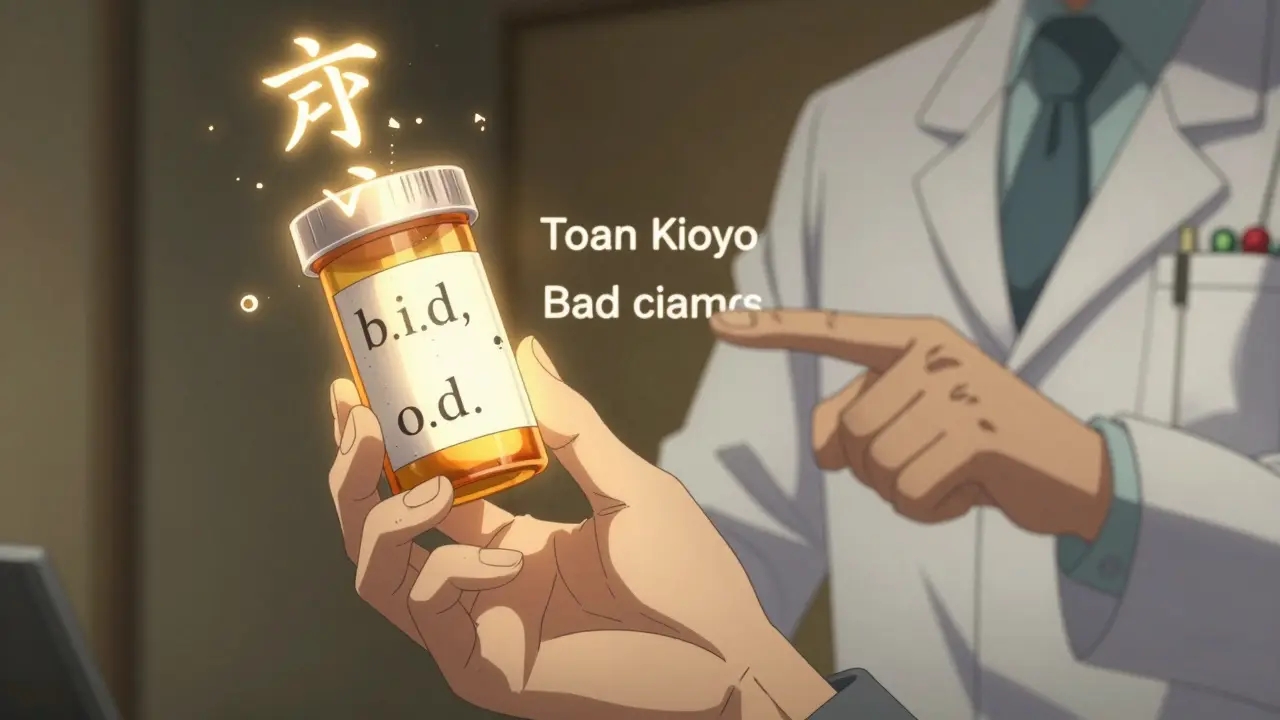
Ever looked at your prescription label and seen Rx, b.i.d., or o.d. and wondered what it actually means? You’re not alone. These shorthand codes are everywhere on medication bottles - but they’re not always clear, and in some cases, they can be dangerous.
Why Do Prescription Labels Use Latin Abbreviations?
The roots of these abbreviations go back hundreds of years. Back in the 1500s, doctors wrote prescriptions in Latin so they’d be understood across Europe, even if patients didn’t speak the same language. The symbol Rx comes from the Latin word recipe, which means “take.” That’s why you see it at the top of every prescription - it’s not a brand or a code, it’s an instruction. Over time, these Latin terms became standard in medical practice. But today, they’re not just outdated - they’re risky. In 2023, the Institute for Safe Medication Practices found that nearly 7% of all medication errors in U.S. hospitals were tied to confusing abbreviations. That’s not a small number. It’s the difference between getting the right dose and ending up in the ER.Common Abbreviations and What They Really Mean
Here’s what you’re likely to see on your label - and what you should actually be reading:- Rx = Prescription (from Latin recipe)
- b.i.d. = Twice daily (from Latin bis in die)
- t.i.d. = Three times daily (from Latin ter in die)
- q.d. = Daily (from Latin quaque die) - but many pharmacies now write “daily” instead because people confuse it with q.i.d. (four times daily)
- p.o. = By mouth (from Latin per os)
- SC or SubQ = Under the skin (subcutaneous)
- o.d. = Right eye (from Latin oculus dexter)
- o.s. = Left eye (from Latin oculus sinister)
- a.d. = Right ear (from Latin auris dexter)
- a.s. = Left ear (from Latin auris sinister)
- PRN = As needed (from Latin pro re nata)
- OTC = Over-the-counter (not a Latin term, but often mixed in)
Some of these are straightforward. Others? Not so much. Take o.d. - it looks like it could mean “overdose,” but it doesn’t. In 2022, the American Academy of Ophthalmology reported that misreading o.d. as “overdose” led to over 2,100 medication errors in eye drops alone. That’s not a typo. That’s a safety failure.
The Dangerous Ones: Abbreviations That Can Kill
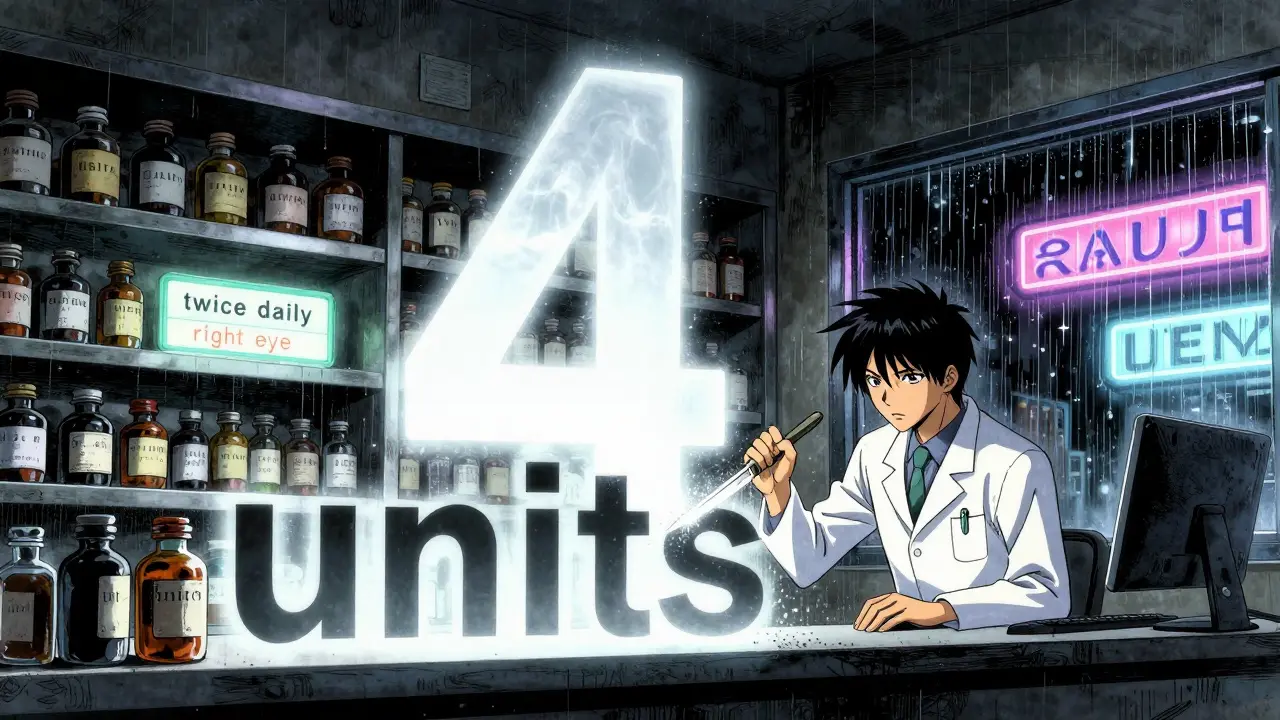
Not all abbreviations are created equal. Some are so risky, they’ve been banned in hospitals and pharmacies across North America. The Joint Commission’s “Do Not Use” list includes:- U for units - easily mistaken for “4” or “0.” In Pennsylvania, 12 deaths between 2018 and 2022 were linked to this one.
- IU for international units - confused with “IV” (intravenous), leading to deadly wrong-route errors.
- QD and QOD - often misread as “QID” (four times daily) or “every other day.”
- MS - could mean morphine sulfate or magnesium sulfate. One mix-up can mean the difference between pain relief and cardiac arrest.
- Trailing zeros - writing “1.0 mg” instead of “1 mg.” The extra zero can make someone think it’s 10 mg.
These aren’t hypothetical risks. They’re real, documented, and preventable. In 2023, a pharmacy in Sydney flagged a prescription that said “MSO4” - the pharmacist caught it was meant to be morphine sulfate, not magnesium sulfate. That’s a near-miss that could’ve ended badly.
What’s Changing? The Shift to Plain English
Around the world, things are changing. The UK banned almost all Latin abbreviations in 2019. Now, prescriptions say “twice daily,” not “b.i.d.” - and medication errors dropped by nearly 30%. Canada and Australia are following suit. In the U.S., electronic prescribing systems are forcing the change. Over 90% of hospitals now use systems like Epic or Cerner that auto-convert “q.d.” to “daily,” “b.i.d.” to “twice daily,” and “U” to “units.” If a doctor types “U,” the system flags it and asks them to rewrite it. Community pharmacies are catching up too. CVS, Walgreens, and Walmart now print patient labels in plain English. You won’t see “o.d.” on your eye drop bottle anymore - you’ll see “right eye.” That’s a big win for patient safety.Why Do Some Doctors Still Use Abbreviations?
It’s not that they don’t know the risks. Many do. But habits die hard. Some doctors say writing “daily” instead of “q.d.” adds seconds to each prescription. For a doctor seeing 40 patients a day, that’s 2-3 extra minutes. In fast-paced clinics, that matters. But here’s the catch: those seconds aren’t worth the risk. The American Medical Association’s 2023 survey showed that 92% of pharmacists want all abbreviations gone. And patients? They’re confused. A 2023 survey found that 68% of people couldn’t correctly interpret common abbreviations on their own prescriptions.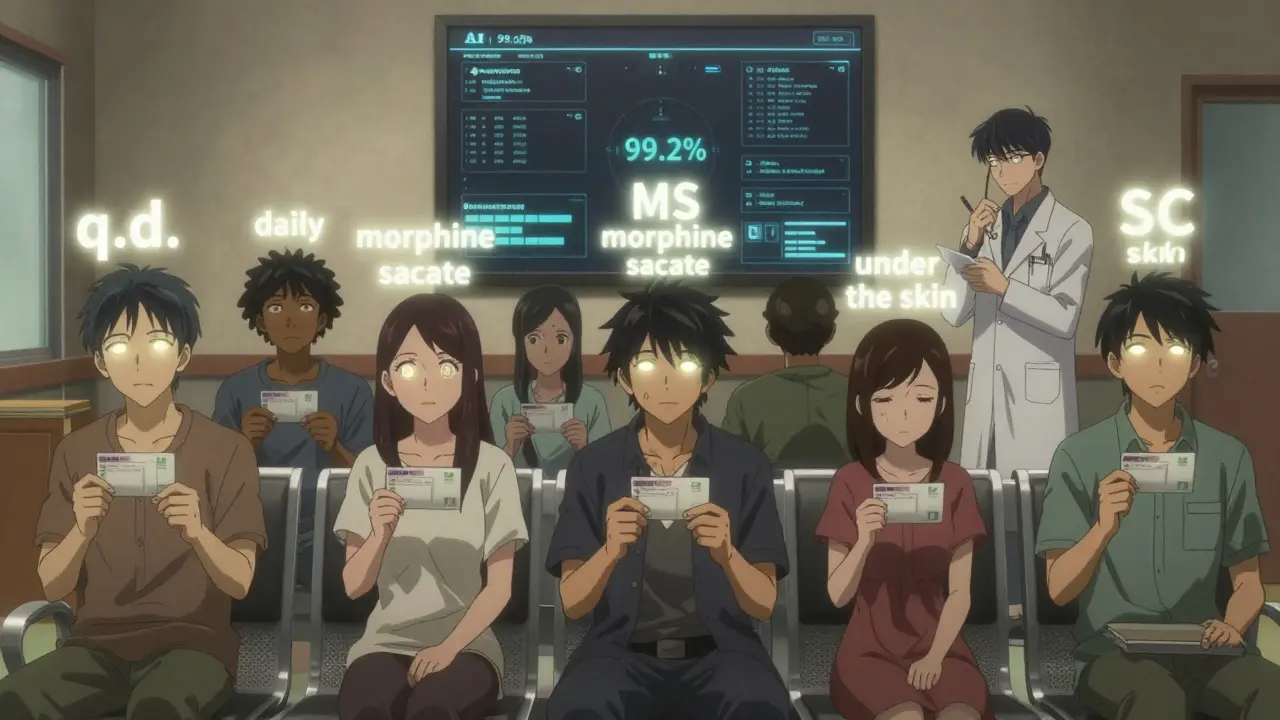
What You Can Do to Stay Safe
You don’t have to be a pharmacist to protect yourself. Here’s how:- Ask your pharmacist - If you see an abbreviation you don’t understand, ask them to explain it. They’re trained to catch these.
- Check your label - If it says “b.i.d.,” ask if it means “twice daily.” If it says “o.d.,” confirm it’s for your right eye.
- Use your phone - Take a picture of the label and send it to your pharmacist if you’re unsure. Most offer free text-based consultations.
- Speak up - If your doctor writes “MS” or “U,” ask them to spell it out. You have the right to understand your meds.
One woman in Melbourne recently called her pharmacy after seeing “SC” on her insulin label. She thought it meant “sublingual” - and nearly took it under her tongue. The pharmacist corrected her: “It’s subcutaneous - under the skin.” That one question prevented a serious error.
The Future: No More Latin on Prescriptions
By 2030, the World Health Organization wants all countries to eliminate non-English abbreviations from prescriptions. Australia is already on that path. New prescribing guidelines from the U.S. Pharmacopeia, effective May 2024, require all prescribers to use plain English - with only a few exceptions like “mg,” “mL,” and “mcg.” AI tools are making this easier. Systems like IBM Watson’s MedSafety AI now auto-convert every abbreviation in real time with 99.2% accuracy. That means in a few years, you might never see “q.i.d.” again - you’ll just see “four times a day.”Final Thought: Your Safety Is Worth the Extra Word
It’s tempting to think, “It’s just a few letters.” But in healthcare, small things have big consequences. That tiny “U” on a prescription could mean the difference between life and death. That’s why the shift to plain language isn’t just about modernizing - it’s about saving lives.Next time you pick up a prescription, take a second to read it like a patient, not a doctor. If something looks strange, ask. You’re not being difficult - you’re being smart.
What does Rx mean on a prescription label?
Rx comes from the Latin word "recipe," which means "take." It’s not a drug name or a code - it’s an instruction from the doctor telling the pharmacist to dispense the medication. You’ll see it at the top of every prescription.
Is q.d. the same as daily?
Yes, q.d. means daily - from the Latin "quaque die." But because many people confuse it with q.i.d. (four times daily), most pharmacies now write "daily" instead to avoid errors. If you see q.d. on your label, ask the pharmacist to confirm it means once a day.
Why is "U" for units dangerous?
"U" can be mistaken for "4," "0," or even "cc." In 2022, the U.S. Institute for Safe Medication Practices reported that "U" caused over 1.3 million medication errors annually - including 12 deaths in Pennsylvania between 2018 and 2022. That’s why hospitals now require you to write "units" in full.
What does o.d. mean on an eye drop label?
o.d. stands for "oculus dexter," which means right eye. But many patients think it means "overdose," leading to dangerous mistakes. Today, most pharmacies print "right eye" instead. If you see o.d. and aren’t sure, always ask.
Are abbreviations still used in Australia?
Yes, but less than before. Australian pharmacies are moving toward plain English labels, following WHO and U.S. guidelines. While some prescribers still use Latin abbreviations, pharmacists are trained to convert them on the label. For example, "b.i.d." becomes "twice daily" on your bottle.
Can I ask my doctor to write out instructions in plain English?
Absolutely. You have the right to understand your medications. If your doctor writes "MS," "U," or "o.d.," say: "Can you please write that out in full?" Most will be happy to clarify - and some are already doing it by default.



Kayleigh Campbell
December 15, 2025 AT 05:23anthony epps
December 16, 2025 AT 10:33Souhardya Paul
December 16, 2025 AT 16:10Dan Padgett
December 18, 2025 AT 01:00Hadi Santoso
December 18, 2025 AT 23:00Tiffany Machelski
December 19, 2025 AT 23:10James Rayner
December 21, 2025 AT 18:13Josias Ariel Mahlangu
December 23, 2025 AT 15:15Arun ana
December 25, 2025 AT 09:21SHAMSHEER SHAIKH
December 26, 2025 AT 19:40Billy Poling
December 26, 2025 AT 23:11Andrew Sychev
December 28, 2025 AT 02:09Dave Alponvyr
December 28, 2025 AT 08:10Colleen Bigelow
December 30, 2025 AT 01:31