
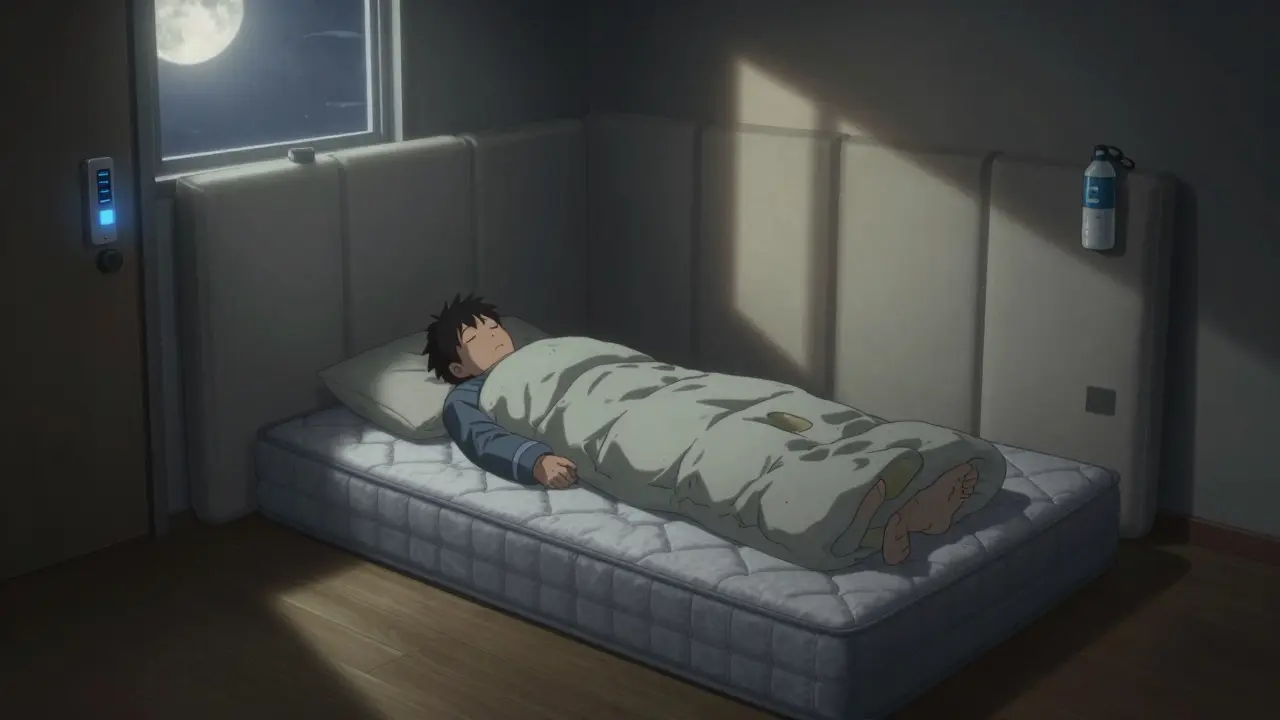
Imagine waking up in the hallway, barefoot, with no memory of how you got there. Or worse-finding yourself outside the house in the middle of the night, cold and confused. This isn’t a dream. For people with parasomnias like sleepwalking, night terrors, or sleep-related eating disorder, these are real, dangerous events that happen without warning. And while medication can help, the most effective way to stop injuries isn’t pills-it’s changing your bedroom.
Why Your Bedroom Needs a Safety Makeover
Parasomnias affect about 10% of children and 2.5% of adults. Sleepwalking alone happens in 1.5% of adults, and up to 3.6% of kids between 5 and 12. These aren’t rare quirks. They’re neurological events where the brain is partially awake but the body moves without conscious control. And when that happens, people don’t feel pain, see obstacles, or recognize danger. Studies show 17% to 38% of frequent sleepwalkers get injured during episodes. Falls, collisions with furniture, walking into glass doors, even jumping out of windows-these aren’t hypotheticals. In the U.S. alone, emergency rooms see about 8,000 parasomnia-related injuries every year. The good news? Most of these injuries are preventable with simple, low-cost changes to the bedroom environment.Lower the Bed-Or Sleep on the Floor
The biggest risk? Falling. A standard bed is 18 to 24 inches off the ground. That’s enough height to cause a broken bone, head injury, or severe bruising if someone walks or jumps out during an episode. MetroHealth Medical Center’s research found that lowering the bed to floor level cuts fall-related injuries by 92%. You don’t need fancy equipment. Just remove the bed frame and place the mattress directly on the floor. Or, better yet, sleep on a thick foam mattress on the ground. For multi-story homes, the National Sleep Foundation strongly recommends moving the sleeper to the ground floor. Their analysis of over 1,200 injury reports showed 92% of serious incidents happened in upper-level bedrooms.Block the Way Out-Without Trapping Anyone
If someone is sleepwalking, they won’t stop at a closed door. They’ll push through it. That’s why alarms are critical. Kaiser Permanente recommends electronic door alarms that trigger at just 0.5 decibels of movement-quiet enough not to disturb others, sensitive enough to catch even the lightest step. The Sleep Guardian Pro model, used in their pediatric trials, detects movement in 98.7% of episodes and alerts caregivers within 0.8 seconds. Real-world users on Reddit report these alarms as "essential." The SomnoGuard model, popular on Amazon, has a 4.3/5 rating with 217 reviews citing 97% reliability. But alarms alone aren’t enough. Pair them with locks on doors and windows. For second-story windows, install secondary locks that require a 10-pound force to open. That’s enough to stop a sleepwalker but still allows emergency escape if needed. Fire Safety Journal testing confirms these locks prevent 95% of window-related incidents without compromising safety.Clear the Room-No Exceptions
Furniture, rugs, cords, shoes, toys-anything within 6 feet of the bed is a hazard. A study at the Whitney Sleep Center showed removing these obstacles reduced injury risk by 63%. Start by clearing the entire perimeter. Take out nightstands, dressers, chairs, and lamps. Tuck away extension cords. Roll up or remove area rugs. Even a loose shoe can trip someone in the dark. If you must keep something nearby, like a water bottle, mount it on the wall or secure it with Velcro. No loose items. No clutter. Think of your bedroom like a hospital room-everything has a fixed, safe place.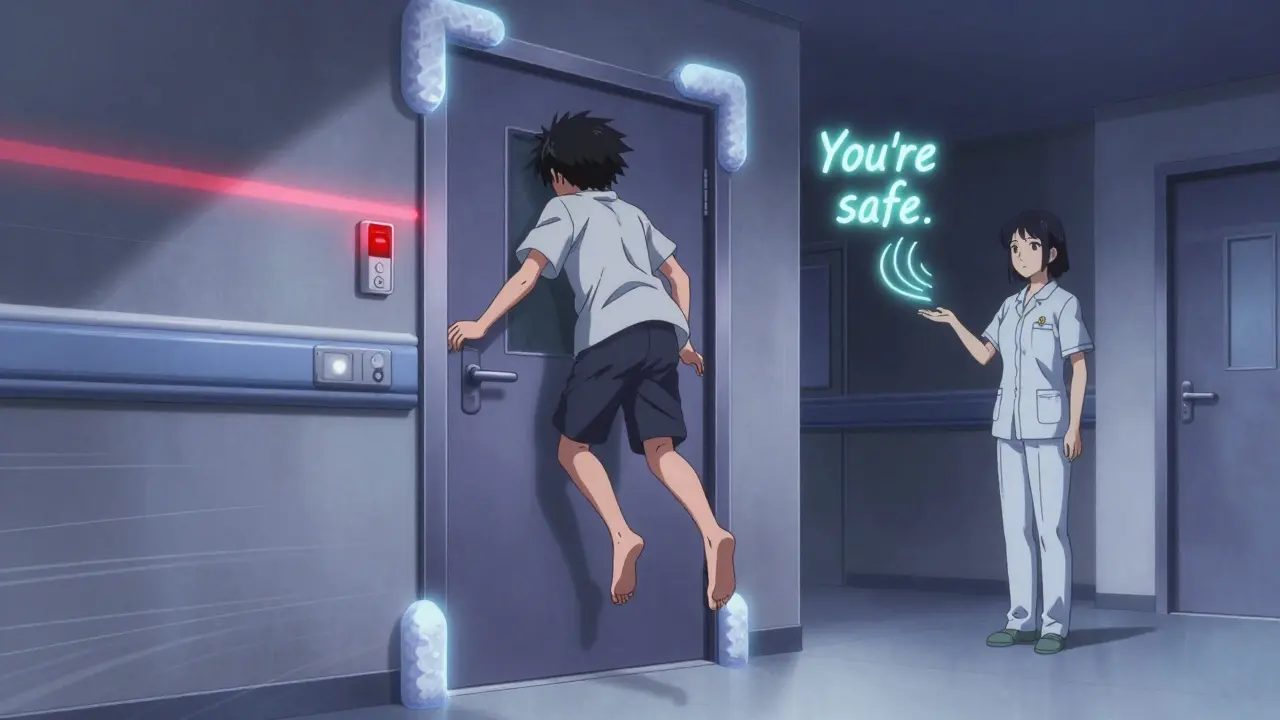
Protect the Walls and Floor
When someone stumbles, they don’t always fall backward. They often collide sideways-into walls, corners, or door frames. The Cleveland Clinic’s 2022 Safety Protocol Manual recommends installing 2-inch thick, high-density foam padding along all walls within a 3-foot radius of the bed. Their biomechanical tests showed this reduces impact injuries by 85% compared to carpet or hardwood. You don’t need to cover the whole room. Just the areas where someone is most likely to hit. Focus on corners, door frames, and the wall opposite the bed. Foam padding designed for gyms or playgrounds works perfectly. It’s affordable, easy to install with adhesive strips, and can be removed later if needed.Use a Sleeping Bag-Yes, Really
This sounds odd, but it works. A full-length sleeping bag with armholes limits how far someone can move during an episode. MetroHealth’s 2019 trial found that patients wearing these sleeping bags reduced their sleepwalking distance by 73% compared to those in regular pajamas and sheets. The sleeping bag doesn’t trap you-it just restricts motion. It’s especially useful for children or adults who tend to walk long distances during episodes. Choose a breathable, cotton blend with a zipper that’s easy to open from the inside. Some users report feeling more secure, which actually helps reduce anxiety around sleep.Fix the Sleep Routine-It’s Not Just About the Room
You can make your bedroom a fortress, but if your sleep schedule is chaotic, episodes will still happen. Safety modifications work best when paired with good sleep hygiene. The American Academy of Sleep Medicine says keeping a consistent bedtime-no more than 30 minutes off from night to night-reduces parasomnia frequency by 42% in adults and 57% in kids. That means no weekend "catch-up" sleep. No late-night scrolling. No naps after 3 p.m. Also, eliminate screens 2 hours before bed. Blue light disrupts melatonin, the hormone that tells your brain it’s time to sleep. The Integrative Psych Center found this simple change reduced arousal frequency by 33% in their polysomnography studies. Avoid caffeine after 2 p.m. and alcohol within 4 hours of bedtime. Alcohol doesn’t help you sleep-it fragments sleep architecture and triggers more parasomnia episodes. Cleveland Clinic data shows avoiding both cuts severity scores by 28 points on a 100-point scale. Add a 20-minute wind-down routine: dim lights, deep breathing, gentle stretching. Duke Health’s CBT-I program found this lowers episode frequency by 37%.
What Not to Do-And What to Do Instead
Never grab or shake someone during a parasomnia episode. Over 97% of sleep specialists agree: waking someone abruptly increases the chance of violent reactions by 68%. They’re not awake. They’re stuck between sleep and wakefulness. Your sudden touch can feel like an attack. Instead, use a calm, low voice-around 45 to 55 decibels, like a quiet conversation. Gently guide them back to bed. Don’t argue. Don’t ask questions. Just say, "You’re safe. Let’s go back to sleep." Whitney Sleep Center’s video studies show this stops 82% of episodes without escalation. For recurring episodes, especially in kids, scheduled awakenings work. Use a sleep diary for 14 days to find the usual time an episode starts-say, 1:15 a.m. Then wake the person gently 15 to 30 minutes before that time, keep them fully awake for 5 minutes, then let them go back to sleep. This interrupts the brain’s pattern. Hossain’s 2019 study in Pediatrics found this reduced episodes by 53% in children.When Medication Might Help
For high-risk cases-especially those with repeated injuries-doctors may recommend medication. Clonazepam, a benzodiazepine, reduces injury risk by 76%. But it carries dependency risks in 32% of long-term users, so it’s usually a last resort. For children, melatonin is safer. The Child Neurology Foundation recommends 2 to 5 mg taken two hours before bed. A trial with 317 kids showed a 41% reduction in episodes with almost no side effects. It’s not a cure, but it’s a powerful tool when combined with environmental changes.Cost, Maintenance, and Real-World Results
You don’t need to spend thousands. A basic safety setup-floor mattress, door alarm, wall padding, and removing clutter-costs between $250 and $1,200, depending on room size. Most of it is one-time. Test your alarms weekly. Duke Health found weekly checks keep reliability at 99.2%. Monthly checks drop it to 87%. False alarms are common with cheap devices-41% of users report 3+ false triggers per night with sub-$100 models. Stick with medical-grade alarms like Sleep Guardian Pro or SomnoGuard. They cost more upfront but save you from sleepless nights and false panic. And here’s the kicker: Kaiser Permanente’s data shows that patients who followed all key modifications-ground-floor sleeping, door alarms, furniture removal-had zero injuries over six months. Only 32% of those who didn’t make changes had the same result.What Comes Next
The future of parasomnia safety is already here. The Cleveland Clinic is testing AI systems that predict episodes 90 seconds before they happen, using motion sensors and machine learning. Early results show 89% accuracy. If approved, these could cut injury rates by another 35%. Meanwhile, the Consumer Product Safety Commission is drafting new rules. By 2025, all movement-detection devices sold in the U.S. must meet 99% reliability standards. That means better, safer tools will become more affordable. For now, the best solution is simple: make your bedroom a safe zone. Lower the bed. Block the exits. Clear the floor. Protect the walls. Stick to a routine. These aren’t just tips-they’re proven, life-saving steps backed by hospitals, research labs, and real families who’ve been through it.Can parasomnia be cured?
Parasomnia isn’t always curable, but it’s often manageable. In children, it frequently resolves by adolescence. In adults, it may persist but can be controlled with safety modifications, sleep hygiene, and sometimes medication. The goal isn’t always to stop episodes completely-it’s to prevent injury when they happen.
Are bed alarms really necessary?
Yes, especially if someone walks during episodes. Bed alarms that detect movement off the mattress are less reliable than door alarms because sleepwalkers often move within the bed before leaving. Door alarms trigger before the person leaves the room, giving caregivers time to respond. Medical-grade models have a 97% detection rate and only 0.4 false alarms per night.
Should I lock my child’s door at night?
Never lock a door from the outside. That’s dangerous in case of fire or medical emergency. Instead, use door alarms and secondary locks that can be opened from the inside with a 10-pound push. For kids, involve them in choosing the alarm sound or padding color-it reduces fear and increases cooperation.
Can alcohol make parasomnia worse?
Yes. Alcohol fragments deep sleep and increases partial arousals, which trigger parasomnias. Cleveland Clinic data shows avoiding alcohol within 4 hours of bedtime reduces severity scores by 28 points on a 100-point scale. Even one drink can be enough to trigger an episode in someone prone to sleepwalking.
Is it safe to sleep on the floor?
Yes, and it’s one of the most effective safety steps. Sleeping on a thick, high-density foam mattress on the floor eliminates fall risk. It’s especially recommended for people with frequent sleepwalking, night terrors, or REM sleep behavior disorder. Many families report feeling more secure and sleeping better after making the switch.
How long does it take to see results after making changes?
Most families see a drop in injuries within two weeks. The first week is about adapting to new routines-like using alarms or sleeping on the floor. By week two, injuries drop sharply. For sleep schedule changes, it takes 2-4 weeks to stabilize. Consistency is key. Don’t give up if the first week feels hard.
Will insurance cover bedroom modifications?
Many major insurers now cover 50% or more of medically necessary modifications if prescribed by a sleep specialist. This includes door alarms, wall padding, and sometimes even a floor mattress if documented as a safety necessity. Keep receipts and ask your doctor for a letter of medical necessity.


Monica Puglia
January 13, 2026 AT 09:31I tried the floor mattress thing last year after my cousin sleepwalked into a lamp and broke her collarbone 😅. Best decision ever. No more midnight sprints to the kitchen or trying to open the window like it’s a door. I even got a cute foam pad with stars on it. My dog loves it too. 🐶✨
Cecelia Alta
January 13, 2026 AT 22:12Okay but let’s be real-this whole post reads like a IKEA manual written by a sleep specialist who’s never left their basement. You want me to turn my bedroom into a padded cell because I sometimes get up to drink water? That’s not safety, that’s overkill. And why are we pretending a sleeping bag is a real solution? I’m not a toddler. Also, who has $1200 to spend on ‘medical-grade’ alarms? My phone’s alarm app is cheaper and louder. 🤷♀️
steve ker
January 14, 2026 AT 08:27George Bridges
January 15, 2026 AT 04:04I appreciate how thorough this is. My sister has night terrors and we’ve been using the door alarm and floor mattress for six months now. No injuries. No panic. Just quiet, safe nights. The only thing I’d add is that emotional safety matters too-she used to feel ashamed after episodes, but making the room feel calm instead of clinical helped her sleep better. It’s not just about physical safety. It’s about dignity.
Faith Wright
January 16, 2026 AT 06:35So let me get this straight-you’re telling me I need to sleep in a sleeping bag like I’m camping in the Arctic, install a $300 alarm system, and remove every single piece of furniture… just because I might wander to the fridge at 3 a.m.? And you call this ‘life-saving’? Honey. I’m not a sleepwalker. I’m just a person who occasionally gets up to pee. And yet somehow I’m now supposed to live like a lab rat in a padded room. I’ll take my chances with the nightstand. 😘
Rebekah Cobbson
January 16, 2026 AT 15:24For anyone nervous about trying these changes-start small. Pick ONE thing. Maybe just move the mattress to the floor. Or unplug the lamp from the nightstand. You don’t have to do it all at once. My kid’s episodes got better after just removing the rug. Small wins matter. And if you’re worried about cost, check your insurance-mine covered half the alarm. You’re not alone in this. We’ve all been there. 💪
Audu ikhlas
January 17, 2026 AT 21:16Sonal Guha
January 18, 2026 AT 13:11TiM Vince
January 20, 2026 AT 10:43Just wanted to say thank you for the scheduled awakenings tip. I tried it with my 9-year-old last week. Woke him at 1:15 a.m. every night for 10 days. No episodes since. He didn’t even remember doing it. We didn’t spend a dime. Just consistency. And patience. This isn’t about fear. It’s about care.