

Storing controlled substances isn’t just about locking a cabinet. It’s about protecting patients, protecting staff, and staying out of legal trouble. Every year, tens of thousands of pills, patches, and injectables go missing from hospitals and clinics-not because of break-ins, but because of small lapses in process. Someone leaves a vial unattended during a shift change. A nurse grabs a dose without logging it. A bag gets left near the medication cart. These aren’t big crimes. They’re quiet failures. And they add up.
Why This Matters More Than Ever
In 2025, the DEA requires any facility handling more than 10 kilograms of Schedule II drugs annually to have real-time inventory tracking. That’s not a suggestion. It’s the law. And if you’re still using paper logs or a single locked cabinet with no access record, you’re already non-compliant. The fines start at $187,500 per violation. But the real cost isn’t the fine-it’s the patient who gets infected because a diverted syringe was reused, or the family that sues because their loved one didn’t get the pain relief they needed because the drug was stolen.
Diversion doesn’t just happen in big hospitals. It happens in small clinics, nursing homes, and even dental offices. The ASHP reports that 68% of major diversion cases occurred during manual handoffs-like when a nurse takes a dose from the pharmacy cart to the floor and no one checks the count. That’s the gap. That’s where you fix it.
Physical Storage: Locks Aren’t Enough
Let’s start with the basics: where you keep the drugs. A locked cabinet isn’t enough if it’s in a corner where no one can see it. The NIH recommends that storage areas be visible, with no blind spots. Personal bags, purses, and backpacks are banned from medication areas in top-performing facilities-because 31% of diversion cases involved someone slipping drugs into their bag during a shift.
For smaller clinics with limited budgets, dual-control access is the minimum standard. That means two authorized people must be present every time the cabinet is opened. One unlocks it. The other watches. Both sign the log. No exceptions. This adds time, yes-but it cuts risk by up to 89%, according to Mayo Clinic data.
For larger facilities, automated dispensing cabinets (ADCs) are the gold standard. These are smart lockers that require two-factor authentication-like a badge and a fingerprint. Every dose taken is recorded with the user’s ID, time, and location. Studies show facilities using ADCs with dual authentication reduce diversion incidents by 73%. The catch? Each unit costs between $45,000 and $75,000. For a small rural clinic, that’s a stretch. But if you’re handling more than 50 controlled substances a week, the investment pays for itself in reduced audits, lower insurance premiums, and saved reputations.
Process Over Hardware
Even the best ADC won’t stop someone who knows how to game the system. That’s why process matters more than hardware. Here’s what works:
- Count everything, every time. When a new shipment arrives, two people count it together. When a dose is dispensed, two people verify the removal. When a vial is returned or wasted, it’s witnessed and logged. No one works alone with controlled substances.
- Track every handoff. If a nurse takes a dose from the pharmacy to the ward, it’s documented. If it’s transferred from the ADC to a floor stock, it’s documented. Manual entries? They’re red flags. Use electronic logs whenever possible.
- Limit who can access. Only pharmacists, nurses, and technicians who need the drugs for direct patient care should have access. No administrative staff. No cleaners. No students. No exceptions.
- Review logs daily. A pharmacist should check the ADC and vault logs every morning. Look for outliers: someone who takes 10 doses in 20 minutes. Someone who wastes the same drug every shift. Someone who always works late. These aren’t coincidences. They’re warnings.
One hospital in Ohio cut diversion by 74% after banning personal bags and adding dual authentication to their vault. But it wasn’t easy. Staff pushed back. They said it slowed them down. So the pharmacy team ran three mandatory training sessions. After six months, 89% of staff said they felt safer. That’s the shift you need to make.

The Hidden Risks: What Nobody Talks About
Most people think diversion means someone steals oxycodone to sell. But the most common method? Replacing stolen drugs with saline.
Here’s how it works: A nurse takes a vial of fentanyl. Then they draw up the same volume of saline and label it “fentanyl 50 mcg.” They put it back. The count looks right. The patient gets saline instead of pain relief. They suffer. The nurse gets caught later-because the patient didn’t improve, or because an audit flagged a mismatch between doses ordered and doses administered.
The ASHP is updating its guidelines in 2024 to specifically address this. They’re calling it “fluid substitution.” And it’s why you need to train staff to recognize it. If someone is wasting more saline than usual, or if a patient’s pain isn’t controlled despite documented doses being given-that’s a signal.
Another hidden risk? Compounding. When a pharmacist mixes a custom dose-say, a diluted morphine solution for a pediatric patient-that’s a high-risk moment. If it’s done manually, with no witness, and logged on paper, it’s a loophole. The DEA found that 68% of large-scale cases happened during compounding or floor stock transfers. Fix it by requiring two people to prepare and verify every compounded dose.
Technology Is Changing the Game
AI is no longer science fiction in pharmacy security. At Johns Hopkins and Mayo Clinic, new systems use machine learning to spot anomalies. If a nurse normally takes 2 doses of hydromorphone per shift but suddenly takes 12, the system flags it within 48 hours. False alarms dropped by 63%. Diversion cases caught before they escalated went up by 92%.
These aren’t magic. They’re data. The system learns normal behavior-how many doses each person takes, when they take them, which patients they care for. Then it watches for deviations. You don’t need a $1 million system to start. Many ADC manufacturers now offer basic anomaly alerts as part of their software updates. Ask your vendor. If they don’t offer it, it’s time to switch.
What If You Can’t Afford an ADC?
You don’t need to buy an ADC to be compliant. You need to be intentional.
- Use double locks: one key, one code. Keep them separate.
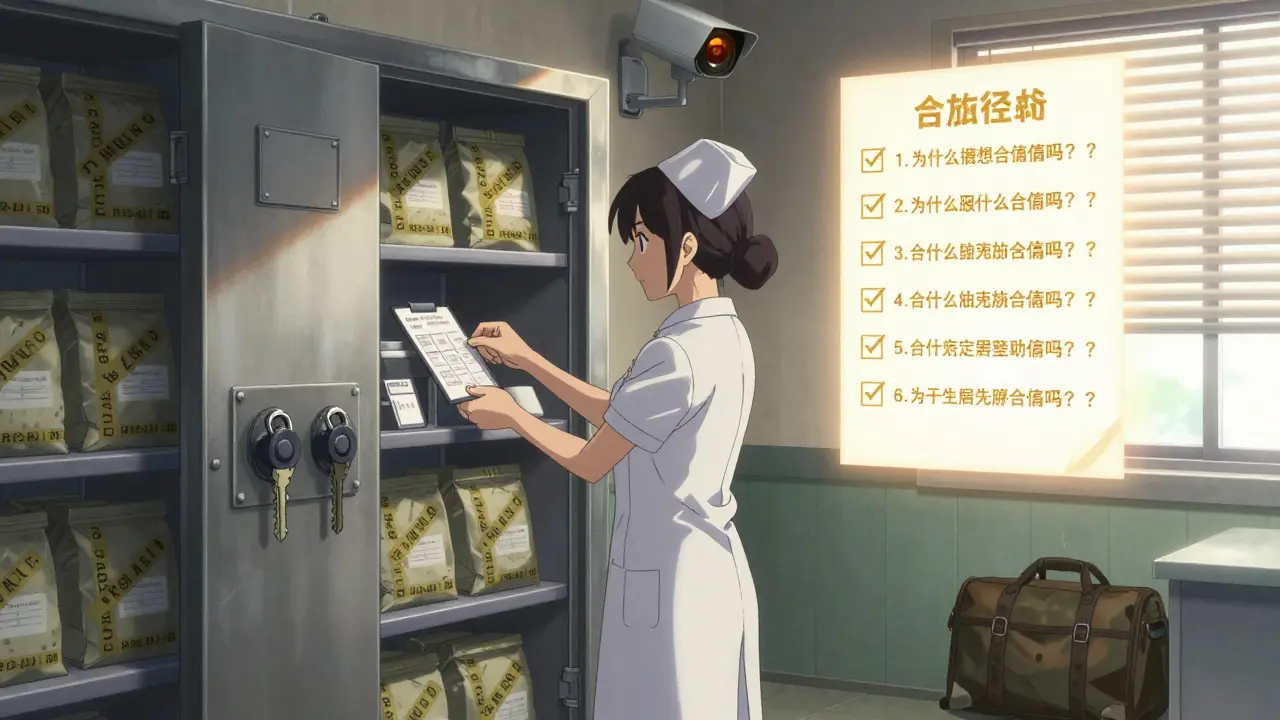
- Install a camera with motion detection pointing at the storage area. Not to spy-just to record access. Review footage weekly.
- Use pre-numbered, tamper-evident bags for every dose taken from the vault. Count them before and after each shift.
- Require a witness for every waste disposal. Use a DEA-approved waste container. Sign off on the form.
- Train staff monthly-not once a year. Use real cases. Show them how it happened elsewhere.
One critical access hospital in rural Australia cut its diversion incidents to zero in 18 months by doing exactly this. No ADC. No fancy software. Just discipline, documentation, and daily checks.
What Happens When You Get Caught?
DEA inspectors show up unannounced. They check your storage areas. They review your logs. They interview staff. In 92% of inspections, they ask to see the vault and the ADC records. If you’re missing a signature, if a count doesn’t add up, if a bag was left unattended-you’re in trouble.
Penalties aren’t just financial. Your DEA registration can be suspended. Your license can be revoked. Your facility can be barred from receiving federal funds. And if a patient is harmed? You could face civil lawsuits that cost hundreds of thousands of dollars.
The best defense? Prove you’re trying. Show your policies. Show your training records. Show your daily review logs. Show that you’re not just following the rules-you’re building a culture of accountability.
Final Checklist: Are You Ready?
Before you close your doors tonight, ask yourself these questions:
- Is every controlled substance stored in a locked, visible, and monitored area?
- Are personal bags and belongings banned from medication zones?
- Is every access to the storage area logged and tied to a person?
- Are two people required for every dose taken, dispensed, or wasted?
- Are daily logs reviewed by a pharmacist?
- Are staff trained on fluid substitution and other hidden diversion methods?
- Do you know who takes the most controlled substances-and why?
If you answered no to any of these, fix it this week. Not next month. Not when the audit notice comes. Now.
What are the legal requirements for storing controlled substances in Australia?
Australia regulates controlled substances under the Therapeutic Goods Act 1989 and state-based Poisons and Therapeutic Goods Regulations. While there’s no federal equivalent to the U.S. DEA, all facilities must store controlled drugs in locked, secure cabinets with access limited to authorized personnel. Records must be kept for at least two years, and any loss or theft must be reported to the local health authority immediately. Most states require dual control for Schedule 8 drugs (like morphine and fentanyl). Always check your state’s specific rules-Sydney, for example, has stricter storage rules than rural areas.
Can a nurse take a controlled substance home for a family member?
No. Never. Even with good intentions, taking a controlled substance for personal use-even for a family member-is a felony. It’s considered diversion. The DEA and Australian health authorities treat this as seriously as selling drugs. There are no exceptions. If a patient needs pain relief at home, the correct path is a prescription from a licensed provider, not a nurse taking it from the facility.
How often should controlled substance inventories be counted?
At minimum, a full count should be done weekly. But for high-risk drugs like opioids and sedatives, daily counts are best practice. Automated systems can do this automatically. Manual systems require two staff members to count together, sign off, and file the record. If you notice a consistent shortage of even one or two doses per week, investigate immediately. Small losses add up fast.
What’s the difference between diversion and theft?
Theft is when someone steals drugs from outside the facility-like a burglar breaking in. Diversion is when someone inside the system-nurse, pharmacist, technician-takes drugs for personal use, resale, or to give to someone else. It’s more common, harder to detect, and far more damaging because it breaks trust. Most diversion starts small: a dose taken for a headache, then a dose for a friend, then a habit. That’s why early detection matters.
Do I need to report a missing dose if it’s just one?
Yes. Always. Even one missing dose is a red flag. It could be a mistake-but it could be the start of a pattern. Reporting it triggers an internal review. You might find a logging error, a miscount, or a staff member struggling with substance use. Ignoring it makes you complicit. The DEA and Australian health regulators expect you to investigate every discrepancy, no matter how small.
Are there alternatives to automated dispensing cabinets for small clinics?
Yes. For clinics under 50 beds, use a dual-lock system: one key held by the pharmacist, one code held by the charge nurse. Install a camera with motion detection. Use pre-numbered, tamper-evident bags for every dose. Require two signatures for every removal. Train staff monthly. Review logs daily. These steps cost less than $5,000 total and can be just as effective as an ADC if followed strictly.
Next Steps: Start Today
Don’t wait for an audit. Don’t wait for someone to get hurt. Start by mapping out every point where a controlled substance changes hands-from delivery to disposal. Write down where the risks are. Then fix them. One at a time.
Get your team together. Show them the facts. Show them what happened at other clinics. Show them how easy it is to slip up-and how hard it is to recover. Make this about safety, not just rules.
Because in the end, this isn’t about compliance. It’s about people.



Crystel Ann
January 16, 2026 AT 04:31This is the kind of stuff that saves lives, even if no one ever notices it happened.
Jan Hess
January 16, 2026 AT 09:21Love the focus on culture over compliance. Training monthly instead of yearly? That’s the move. My unit started doing daily log reviews last quarter and the staff actually started calling out weird patterns themselves. No one wants to be the person who messed up someone’s pain meds.
Nilesh Khedekar
January 17, 2026 AT 05:55Interesting how you mention Australia’s rules… but let’s be real, most places don’t even have locked cabinets. I’ve seen IV bags sitting on the counter during shift change. And you think the DEA cares? They show up, write a fine, and leave. Meanwhile, the nurse who took the fentanyl is still working next week. This whole system is a joke.
Niki Van den Bossche
January 18, 2026 AT 08:34Fluid substitution isn’t just a loophole-it’s a metaphysical betrayal. We’ve turned healing into a ledger, and the soul of care has been replaced by barcode scans and dual-authentication rituals. The real tragedy isn’t the stolen morphine-it’s that we’ve normalized the idea that human trust can be encrypted. We’ve become accountants of agony.
Nat Young
January 19, 2026 AT 09:0873% reduction with ADCs? That’s statistically significant but practically meaningless if you’re a rural clinic with 3 nurses and a budget of $12k. Also, who’s auditing the auditors? How many times have you seen a pharmacist log a dose as ‘wasted’ when it was actually given to a friend? The system doesn’t prevent abuse-it just gives you paperwork to pretend you’re doing something.
RUTH DE OLIVEIRA ALVES
January 19, 2026 AT 12:32Per the Therapeutic Goods Act 1989 and relevant state regulations, all Schedule 8 substances must be stored in a locked, secure cabinet with restricted access limited to authorized personnel. Records must be maintained for a minimum of two years, and any loss or theft must be reported immediately to the local health authority. Dual control is mandated for Schedule 8 drugs in all Australian jurisdictions, though specific implementation varies-New South Wales requires biometric access, while Queensland permits key-and-code systems with documented justification. Compliance is non-negotiable, and failure to adhere may result in suspension of prescribing privileges and criminal liability under the Poisons Act.
Haley Graves
January 20, 2026 AT 21:52Stop waiting for the audit. Start today. Grab your team. Walk through every step from delivery to waste. Write down where the gaps are. Then fix one thing. Then another. Don’t make it perfect-make it consistent. People don’t need a fancy system. They need to know you care enough to show up, every day.
Jami Reynolds
January 22, 2026 AT 01:11AI anomaly detection? That’s just surveillance dressed up as innovation. They’re tracking nurses’ behavior like prisoners. What’s next-mandatory breathalyzer tests before handling meds? This isn’t security, it’s control. And control doesn’t prevent theft. It just drives it underground. You can’t algorithm your way out of a broken system.
Sarah Mailloux
January 23, 2026 AT 07:07My boss said we can’t afford an ADC so we started using those pre-numbered tamper bags and a second lock. One key with the pharmacist, one code with the charge nurse. We’ve had zero incidents in 14 months. No one complained after the first week. Turns out people just want to feel safe doing their job.
Dan Mack
January 24, 2026 AT 05:10They say diversion is about one nurse stealing. But what if it’s bigger? What if the whole system is rigged? What if the pharmacies are inflating inventory to cover up bulk theft? What if the DEA doesn’t want you to find out because they’re in bed with the drug companies? You think they want you to fix this? They want you to keep paying for ADCs so they can keep collecting fines. This isn’t about safety. It’s about profit.