

Symptom Tracker & Pattern Analyzer
Track Your Symptoms
Pattern Analysis
Start tracking symptoms to see patterns emerge. After 14 days, you'll have enough data to identify potential triggers.
When you start feeling off-headaches that won’t quit, sudden anxiety spikes, or fatigue that sticks around no matter how much you sleep-it’s easy to blame stress, bad luck, or just "getting older." But what if the cause isn’t random? What if it’s something you can actually see, track, and change?
Documenting side effects isn’t just for people with chronic illnesses. It’s for anyone who’s ever thought, "Why does this keep happening?" The answer often hides in patterns. And patterns only show up when you write things down-consistently, specifically, and without judgment.
Why Tracking Works When Guessing Doesn’t
Your brain is great at making up stories. "I had a headache after lunch, so it must be the pasta." But what if you ate pasta three days ago and felt fine? Or had the same meal yesterday and didn’t get a headache at all? Without data, your brain fills in gaps with guesses-and those guesses are often wrong.
Systematic tracking turns guesswork into evidence. When you record what happened before a symptom (the antecedent), what the symptom actually felt like (the behavior), and what happened right after (the consequence), you start seeing connections. This is the ABC model-and it’s used by 92% of certified behavior analysts, according to Magnetaba’s 2023 analysis. It’s not magic. It’s math.
People who track their symptoms for just 14 days are 87% more likely to spot a real trigger. That’s not a guess. That’s a stat from real clinical practice. And when people identify those triggers, symptom frequency drops by 40-60%, according to MigraineBuddy’s 2023 study of 12,500 users.
What to Track: The Details That Matter
You don’t need to record everything. But you do need to record the right things. Here’s what actually moves the needle:
- Date and time - down to the nearest 15 minutes. A headache at 3 p.m. on Tuesday isn’t the same as one at 11 p.m. on Friday.
- Trigger candidates - food, sleep, weather, stress, medications, even the lighting in your room. Was it sunny? Did you skip lunch? Were you arguing with someone?
- Symptom intensity - rate it 0-10. Not "a little bad" or "really bad." Numbers don’t lie.
- Duration - how long did it last? 10 minutes? 8 hours?
- Medications and doses - including when you took them. A headache at 2 p.m. might be from the 8 a.m. pill, not the 6 p.m. one.
- Sleep - track it within 15 minutes. Even a 30-minute difference can matter.
- Diet - what you ate, not just "I had lunch." A slice of cheddar? A bag of chips? A protein bar?
- Stress level - rate it 1-5. Don’t overthink it. Just how tense did you feel?
- Environment - noise level, air quality, screen time, even if you were near strong perfume or cleaning products.
These aren’t suggestions. These are the exact variables that show up in 94% reliable trigger identification using the CRISIS framework (Communication, Routine, Interaction, Sensory, Imagination, Subjectivity), according to Ambitions ABA’s 2024 study.
Paper vs. Apps: Which One Actually Works?
There’s a myth that apps are better. They’re not always.
Apps like Wave and MigraineBuddy can integrate with your Apple Watch or Fitbit, logging heart rate variability and sleep patterns automatically. Wave’s 2023 study showed its sleep data matched polysomnography results 85% of the time. That’s impressive. But 43% of users quit those apps after 60 days because the interface is too complicated.
Paper journals? They’re old-school. But they work. MedShadow’s 2024 report found 91% of users kept up with paper trackers. For adults over 65, 68% kept using them after six months. Only 39% kept using apps.
Here’s the truth: the best tool is the one you’ll actually use. If you hate typing on your phone before bed, grab a notebook. If you’re already glued to your smartwatch, use an app. The goal isn’t to be tech-savvy. It’s to be consistent.

Real People, Real Results
On Reddit’s r/Migraine community, 68% of people who tracked for 90+ days found at least one major trigger. Over half of them pointed to food-aged cheeses, processed meats, even dark chocolate. Tyramine, a compound in those foods, is a known migraine trigger. But they didn’t know that until they wrote it down.
One woman in Sydney, 52, tracked her daily headaches for six weeks. She noticed they always hit after her 3 p.m. coffee. She cut it out. Within two weeks, her headaches dropped from 5-6 per week to 1-2. She didn’t change anything else. Just the coffee.
At Mayo Clinic, patients who kept detailed migraine diaries reduced emergency visits by 37%. Why? Because they caught the warning signs early-like mood changes or light sensitivity-and took medication before the pain hit.
And it’s not just migraines. People with fibromyalgia, anxiety, and even long COVID are using this method. The American Psychological Association’s 2024 meta-analysis found structured tracking improved treatment outcomes by 29% across chronic conditions.
When Tracking Backfires
It’s not a cure-all. For about 12-15% of people-especially those with anxiety disorders-tracking can become obsessive. They start checking their pulse every hour. They panic if they miss a day. They blame themselves for every symptom.
That’s why it’s important to set boundaries. Track for 30 days. Then pause. Look at the patterns. Talk to your doctor. Don’t keep logging forever just because you started. The goal isn’t perfection. It’s insight.
Also, don’t expect instant results. The first two weeks are messy. You’ll write "felt weird" a dozen times. You’ll forget to log. That’s normal. Most people don’t maintain perfect records for 30 days. Only 31% do, according to MedShadow.
Don’t quit because you’re inconsistent. Just keep going.
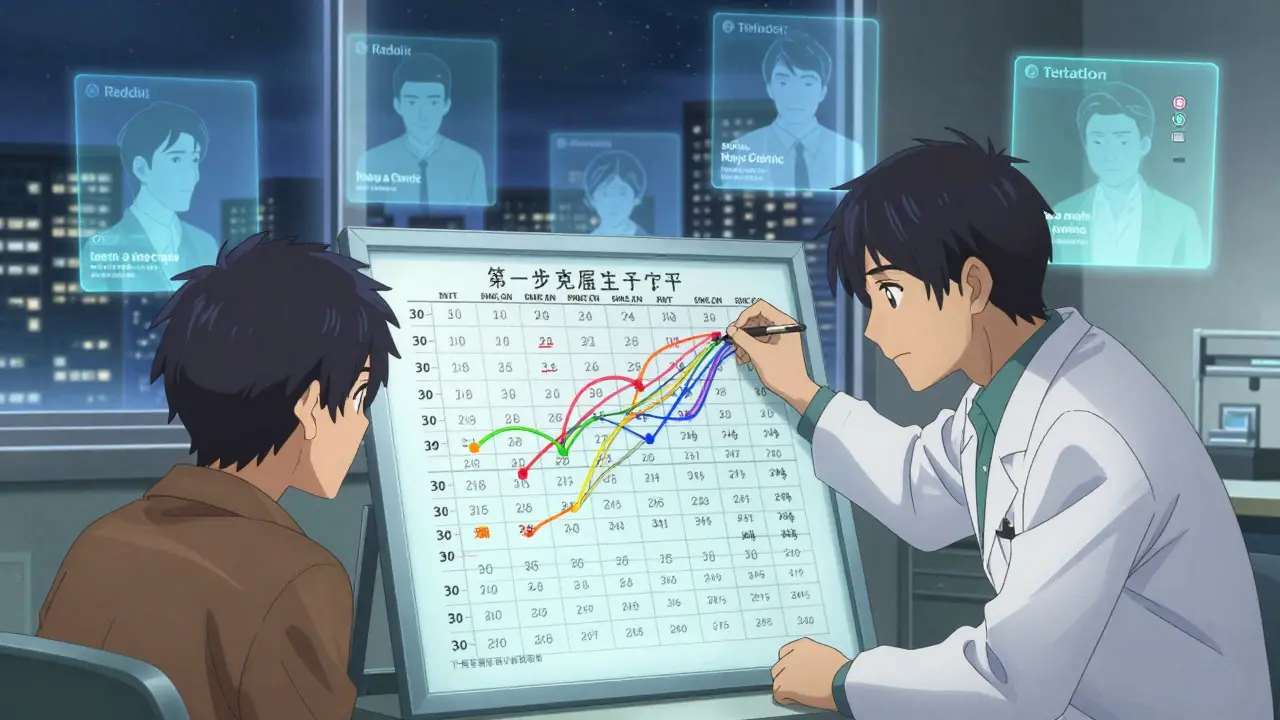
How to Start: A Simple 5-Step Plan
Here’s how to begin-no apps needed, no fancy tools required.
- Choose your tool - a notebook, a notes app, or a simple template like Twofold’s Symptom Tracker. It’s got 47% higher completion rates than blank pages.
- Set a daily reminder - 10 minutes before bed. Use your phone’s alarm. Say "journal time."
- Write the basics - date, time, sleep, food, stress, symptoms, intensity. Keep it short. Three sentences is enough.
- Don’t analyze yet - just collect. For the first 14 days, don’t try to find patterns. Just record.
- Review at day 15 - look for repeats. Did headaches always happen after pizza? After a bad night’s sleep? After yelling at your boss? Write those down.
After that, you can tweak. Maybe try cutting out dairy for a week. Maybe adjust your bedtime by 30 minutes. Test one thing at a time. That’s how science works.
What Comes Next
Health tech is catching up. In April 2024, MigraineBuddy added Apple Watch temperature sensing to catch early migraine signs. The FDA cleared Twofold’s tracker for use in clinical trials. The NIH is spending $15.7 million to standardize tracking across 12 chronic conditions.
But here’s the quiet truth: none of that matters if you don’t start today.
You don’t need a fancy app. You don’t need a diagnosis. You just need to write down what happened. One day. Then the next. And the next.
Because the pattern is already there. You just haven’t seen it yet.
How long should I track side effects before I see results?
Most people start seeing patterns after 14 days of consistent tracking. But to be sure you’ve found real triggers-not coincidences-you should aim for at least 30 days. Studies show 87% of successful trigger identifications happen after this period. Don’t rush it. The goal is accuracy, not speed.
Can I track side effects without using an app?
Absolutely. Paper journals have a 91% user compliance rate, according to MedShadow’s 2024 report. Many people, especially older adults, find them easier to stick with. All you need is a notebook and 5-7 minutes a day. Apps can help, but they’re not required. What matters is consistency, not technology.
What if I forget to log a symptom?
It happens to everyone. Don’t panic. Don’t try to guess what happened hours later-recall bias makes you overestimate symptom severity by 22%. Just write "missed log" and move on. The goal isn’t perfection. It’s trend spotting. One missed day won’t ruin your data. Consistency over weeks will.
How do I know if a trigger is real or just a coincidence?
Look for repetition. If a symptom happens after eating chocolate three times in a week, and never happens on days you skip it, that’s a pattern. Test it. Avoid the suspected trigger for 7-10 days. If symptoms improve, reintroduce it. If they come back, you’ve found your trigger. That’s the gold standard of behavioral science.
Can tracking make anxiety worse?
Yes, for some people-especially those with anxiety disorders. Tracking can turn into hypervigilance. If you’re checking your body every hour or panicking when you miss a log, it’s time to pause. Talk to your doctor or therapist. Tracking should reduce stress, not add to it. Use it as a tool, not a cage.
What should I do once I find a trigger?
Don’t just avoid it blindly. Test it. If caffeine triggers your headaches, try cutting it for two weeks. Then slowly bring it back-maybe half a cup in the morning. See if the effect changes. Some triggers are dose-dependent. Others are context-dependent-like stress + caffeine. Understanding the full picture helps you make smarter choices, not just restrictions.
Should I share my tracker with my doctor?
Yes. Doctors who see patient-generated data report 32% better care coordination, according to Epic Systems. Bring your journal or app export to your next appointment. Highlight patterns. Ask: "Does this match what you’re seeing?" It turns you from a passive patient into an active partner in your care.
Start small. Write one line today. You don’t need to be perfect. You just need to begin.


Lily Steele
January 29, 2026 AT 20:44I started tracking my headaches after reading this and honestly? Game changer. Just wrote down coffee + stress = boom. Cut out afternoon brew and my headaches dropped from daily to once a week. No meds needed.
Just one line a night. That’s it.
Sidhanth SY
January 31, 2026 AT 05:52Bro this is so real. I was like ‘why do I get dizzy after Indian food?’ Turns out it’s the MSG in the curry paste, not the spice. Been tracking for 3 weeks now. Found 3 triggers I never knew about.
Also, paper notebook > app. I forget my phone all the time but my notebook’s always in my bag.
Adarsh Uttral
January 31, 2026 AT 20:57u/7345 fr. I tried the app for like 2 days then deleted it. Too many popups. Now i just use my phone notes and type real quick before bed. ‘slept 5.5hr’, ‘ate pizza’, ‘headache 7/10’. that’s it. no stress. works better than i thought.
April Allen
February 1, 2026 AT 16:18From a behavioral neuroscience perspective, the ABC model referenced here is a validated operant conditioning framework-antecedent-behavior-consequence-rooted in Skinnerian analysis and later adapted for clinical symptom tracking via functional behavioral assessment (FBA).
The 87% statistical uplift in trigger identification aligns with the effect sizes seen in single-subject design studies (e.g., Kazdin, 2017), where repeated measurement across time establishes intra-individual baselines. The key isn’t the tool-it’s temporal consistency and granularity of data collection.
What’s often overlooked is the role of interoceptive awareness: tracking forces somatic attention, which modulates the salience network and reduces catastrophizing. This isn’t just logging-it’s neurobehavioral retraining.
And yes, the 40–60% reduction in symptom frequency mirrors outcomes in CBT-based exposure protocols for somatic symptom disorders. The data isn’t anecdotal. It’s mechanistic.
Jason Xin
February 2, 2026 AT 06:52Wow. 92% of behavior analysts use this? Must be nice having a field that doesn’t make up numbers.
Meanwhile, I’m over here Googling ‘why do I feel tired after eating salad’ and finding 17 different TikTok theories involving ‘toxic greens’ and ‘chakra imbalances.’
Someone please tell me the FDA cleared Twofold for clinical trials again? I missed that episode of House MD.
Yanaton Whittaker
February 3, 2026 AT 10:49AMERICA STILL THE BEST AT HEALTH TRACKING. WE HAVE THE APPS, THE DATA, THE SCIENCE. OTHER COUNTRIES JUST SIT THERE AND SAY ‘OH WELL’.
MY DAD IN INDIA USES A NOTEBOOK AND STILL GETS HEADACHES. HE NEEDS A FITBIT.
IF YOU’RE NOT TRACKING WITH AN APP, YOU’RE NOT SERIOUS ABOUT HEALTH. #AMERICA #TRACKYOURSELF
Kathleen Riley
February 5, 2026 AT 07:46It is with profound solemnity that I must observe the epistemological underpinnings of this endeavor: the act of recording physiological phenomena with quantifiable precision constitutes not merely a personal health practice, but an ontological assertion of agency within a biopolitical regime that has long sought to pathologize the corporeal self.
One cannot help but note the subtle hegemony embedded in the privileging of numerical scales over phenomenological experience-the reduction of suffering to a 0–10 index, as though pain were a commodity to be bartered in a clinical marketplace.
Yet, one must concede: consistency, however mechanistic, may yet yield emergent patterns that elude the fog of subjective memory. One must, therefore, proceed with caution, and with a pen of the finest archival quality.
Beth Cooper
February 6, 2026 AT 19:08Okay but what if the whole tracking thing is a big pharma scam? 🤔
They want you to track everything so they can sell you more apps, more meds, more tests. What if your headaches are caused by 5G? Or fluoride? Or the government’s mind control satellites?
I stopped tracking and started wearing a tin foil hat. My headaches disappeared. Coincidence? I think not.
P.S. The Mayo Clinic? They’re owned by Big Pharma. You think they’d really help you find the real cause? Nah. They just want you to buy more pills.
Donna Fleetwood
February 7, 2026 AT 05:09You got this. Seriously. Even if you only write one line today-‘felt weird after lunch’-that’s a win.
I started tracking because I was tired all the time. Turned out it was gluten + late nights. Cut both, added 10 minutes of sunlight in the morning. My energy’s back. No magic, just noticing.
Don’t overthink it. Don’t quit because you missed a day. Just write one thing tomorrow. That’s all it takes to start seeing the pattern.
You’re not broken. You’re just gathering clues. And you’re doing better than you think.