
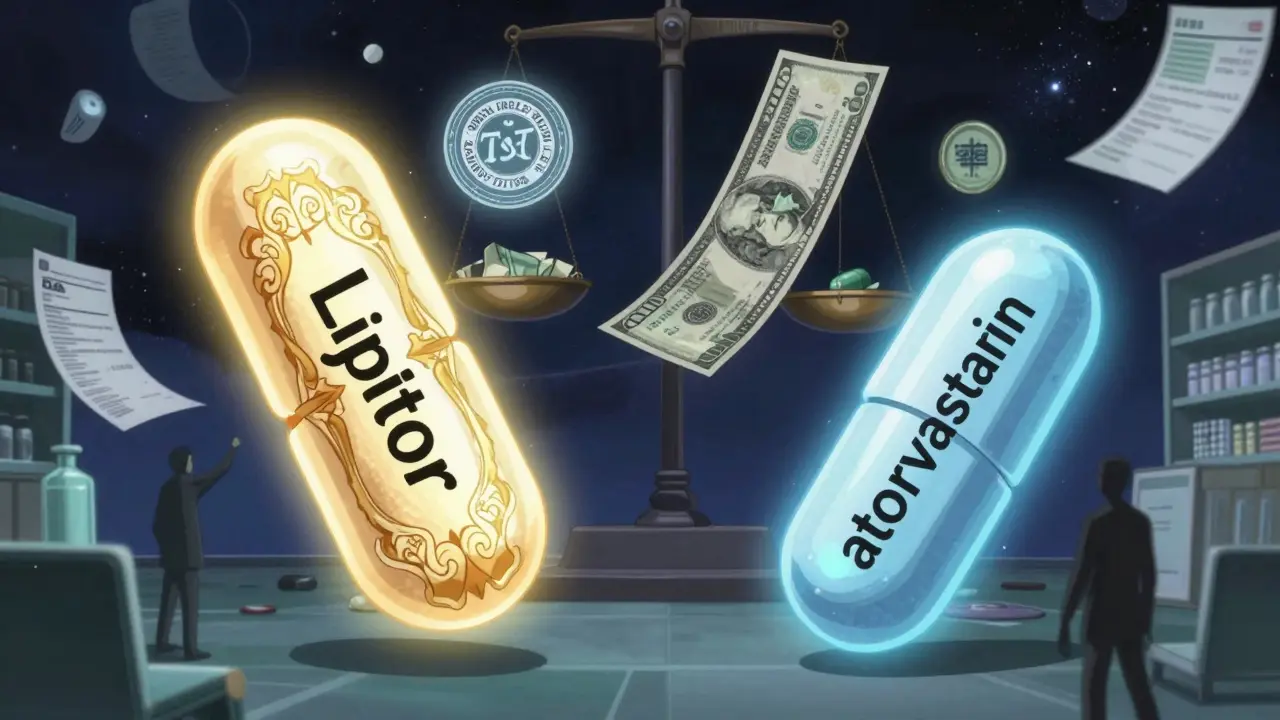
Ever looked at your prescription receipt and wondered why the little white pill in the generic box costs $4 while the brand-name version next to it is $500? It’s not a scam. It’s not magic. It’s basic economics, smart regulation, and a system designed to save you money-without cutting corners on safety.
Same medicine, different price tag
A generic drug isn’t a cheaper version of the real thing. It’s the exact same thing. The same active ingredient. The same dose. The same way it works in your body. If you’re taking generic atorvastatin, you’re getting the same chemical as Lipitor. Same for omeprazole and Prilosec, metformin and Glucophage. The FDA requires it. No exceptions. The only differences? The color. The shape. The name on the pill. The filler ingredients-like starch or dye-that don’t affect how the drug works. These changes are required by law so generic manufacturers can’t copy the brand’s trademarked look. But the medicine inside? Identical.Why brand-name drugs cost so much
Brand-name drugs start as a lab experiment. A scientist spends years trying to find a molecule that treats a disease without killing the patient. Then comes the long, expensive climb to approval. On average, it takes 8 to 12 years and $2.6 billion to bring a new brand-name drug to market. That’s not just research. That’s hundreds of clinical trials. Thousands of patients. Animal studies. Data analysis. Legal filings. Marketing campaigns. And most of that money? Gone before the first pill is sold. Pharmaceutical companies get 20 years of patent protection from the date they file. That’s their chance to make back that investment-and then some. During those 20 years, they’re the only ones allowed to sell it. No competition. No price pressure. Just high margins.How generics skip the $2.6 billion bill
Once the patent runs out, any other company can make the same drug. But they don’t start from scratch. They don’t need to run new animal tests. They don’t need to repeat 10 years of clinical trials proving the drug works. Instead, they file what’s called an Abbreviated New Drug Application (ANDA). All they have to prove is bioequivalence: that their version delivers the same amount of medicine into your bloodstream at the same speed as the brand. The FDA requires this to be within 80-125% of the brand’s levels. That’s tight. That’s science. That’s not a shortcut-it’s a smarter path. Developing a generic drug costs between $1 million and $5 million. That’s less than 0.2% of what it takes to launch a brand-name drug. And it takes months, not years. The FDA reviews these applications in about 10 months on average.
Competition drives prices down
The moment a generic hits the market, the price starts falling. Fast. The first generic maker might charge 30% less. Then another company enters. Then five. Then 14. By the time there are 10 or more manufacturers making the same drug, the price can drop 90%. Take levothyroxine, the thyroid medication. In 2015, the brand-name version, Synthroid, cost around $60 a month. Generic versions? As low as $4. People saved hundreds a year. And that’s not rare. It’s standard. According to the Congressional Budget Office, generic competition typically cuts drug prices by 80-90% in the first year. That’s not inflation. That’s market forces at work.Generics make up 90% of prescriptions-but only 18% of spending
Here’s the mind-blowing part: 90.5% of all prescriptions filled in the U.S. are generics. But they account for just 18% of total drug spending. Brand-name drugs, which make up less than 10% of prescriptions, take up 82% of the bill. That’s not a glitch. That’s the system working. Generics keep the system from collapsing under its own weight. Without them, millions of people couldn’t afford their meds. Diabetes. Blood pressure. Cholesterol. Depression. All of it would be out of reach for many. From 2007 to 2016, generics saved the U.S. healthcare system $1.67 trillion. In 2022 alone, they saved $293 billion.Why people still don’t trust them
Despite all the evidence, a lot of people still think generics are inferior. A Tebra survey in 2023 found that 62% of Americans trust brand-name drugs more-even though 84% admit generics are just as effective. Some of this comes from appearance. If your brand-name pill was a blue oval and your generic is a white circle, your brain might think, “This isn’t the same.” Some comes from bad experiences. A few people report feeling different after switching-especially with drugs that have a narrow therapeutic index, like warfarin or levothyroxine. But here’s the truth: those cases are rare. And when they happen, it’s often because the patient switched between different generic manufacturers, not because generics are flawed. The FDA says all approved generics meet the same standards. So if you switch from one generic to another, and you feel off, it’s not because generics are unsafe. It’s because your body is sensitive to tiny differences in inactive ingredients. Talk to your pharmacist. They can help you stick with the same generic brand if needed.


Coy Huffman
February 4, 2026 AT 03:27pradnya paramita
February 5, 2026 AT 14:59Harriot Rockey
February 6, 2026 AT 20:18Caleb Sutton
February 7, 2026 AT 22:50Jamillah Rodriguez
February 8, 2026 AT 22:32Susheel Sharma
February 9, 2026 AT 19:31Janice Williams
February 11, 2026 AT 07:16Roshan Gudhe
February 11, 2026 AT 17:50Rachel Kipps
February 12, 2026 AT 12:35Wendy Lamb
February 14, 2026 AT 01:14