
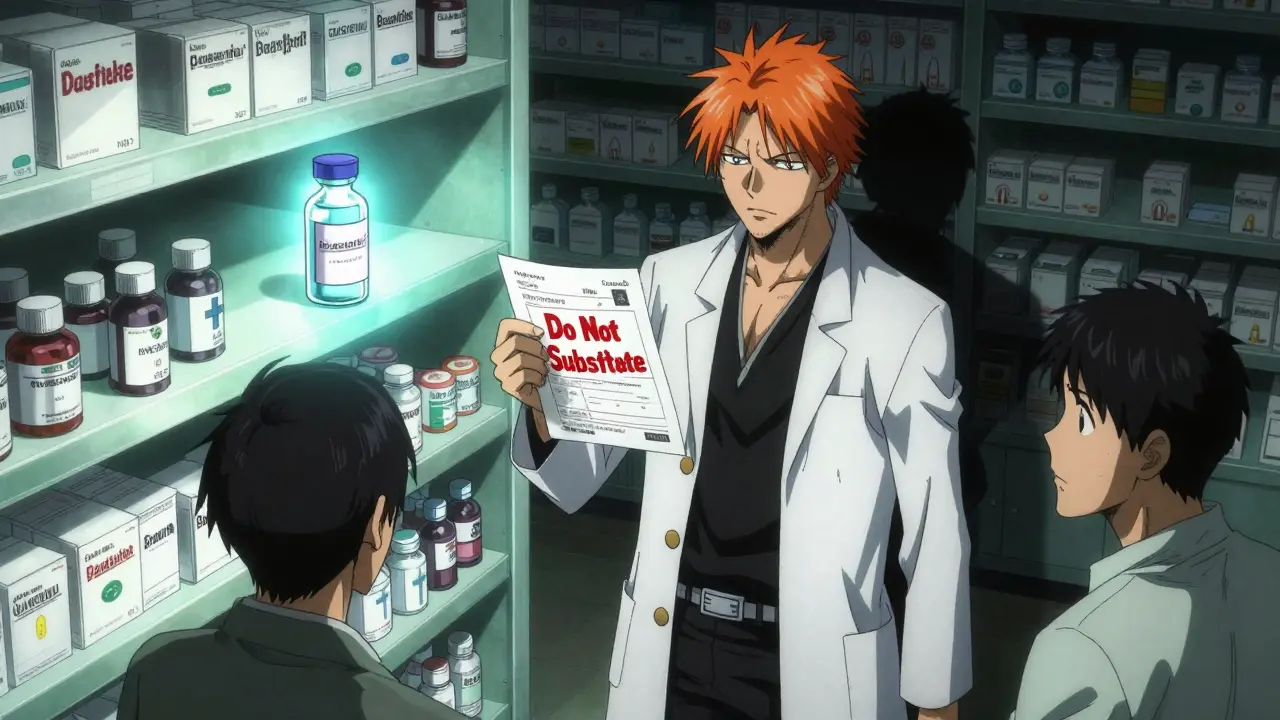
When you pick up a prescription, you probably expect to get the cheapest option available. That’s usually a generic drug - cheaper, just as effective, and approved by the FDA. But sometimes, your doctor writes "Do Not Substitute" on the prescription. And that changes everything. It means the pharmacist can’t swap in a generic, even if it’s 90% cheaper. Why? Because for some medications, that small difference matters.
What "Do Not Substitute" Really Means
"Do Not Substitute" (also called "Dispense as Written" or DAW) is a legal instruction from your doctor. It tells the pharmacy: give this exact brand-name drug. No replacements. This isn’t about preference. It’s not about marketing. It’s about clinical safety. In most cases, generics work fine. The FDA requires them to match the brand drug in active ingredients, strength, dosage form, and how they’re absorbed by the body. But there’s a catch: absorption isn’t always simple. For some drugs, even tiny changes in how the body processes the medicine can lead to serious problems.When Generics Aren’t Enough
Not all drugs are created equal when it comes to substitution. The FDA calls these narrow therapeutic index (NTID) drugs. These are medications where the difference between a helpful dose and a dangerous one is very small. A slight change in how the drug is absorbed can mean the difference between control and crisis. Examples include:- Levothyroxine - used for thyroid conditions. Even a 5% change in absorption can throw off hormone levels, causing fatigue, weight gain, or heart problems.
- Warfarin - a blood thinner. Too much? Risk of bleeding. Too little? Risk of stroke.
- Phenytoin - an anti-seizure drug. A small shift can trigger seizures.
Why Your Doctor Might Say No to Generics
There are three main reasons your doctor might write "Do Not Substitute":- Therapeutic instability - You’ve been on the brand drug for years. Your body is used to it. Switching to a generic, even if it’s "equivalent," might cause your condition to worsen.
- Adverse reactions - Some people react to inactive ingredients in generics. These can include dyes, fillers, or preservatives. If you’ve had a rash, nausea, or dizziness after switching, your doctor may block substitution.
- Complex delivery systems - Some drugs come in special forms: extended-release pills, patches, or prefilled syringes. Even if the active ingredient is the same, changing the delivery system can change how the drug works. Forty-three states ban substitution in these cases.
How Doctors Actually Write "Do Not Substitute"
It’s not enough to just say "no generics." The law requires specific wording. In most states, your doctor must write one of these phrases on the prescription:- "Do Not Substitute"
- "Dispense as Written"
- "Medically Necessary"
The Cost of "Do Not Substitute"
The average patient pays 237% more for a brand drug with a DNS order. For Medicare patients, 12.7% of prescriptions have this designation - compared to 8.3% for private insurance. That’s because Medicare often covers expensive specialty drugs where substitution is riskier. But here’s the problem: most patients don’t know why they’re paying more. A Kaiser Family Foundation survey found that 68% of people who got a "Do Not Substitute" prescription didn’t realize the cost difference until they were at the pharmacy counter. Many felt blindsided - and angry. One Reddit user wrote: "My doctor wrote DAW on my Synthroid script. Insurance charged me $85 instead of $10. I had to call three times to find out why." Doctors aren’t always clear about the reason. And pharmacists, even when they want to explain, are often blocked by insurance rules.
When "Do Not Substitute" Is Misused
Here’s the uncomfortable truth: not every "Do Not Substitute" order is medically necessary. Dr. Aaron Kesselheim from Harvard Medical School says: "We’re seeing 25-30% DNS rates in some drug classes where generics are proven safe. That suggests brand promotion, not clinical need." The FDA has reviewed over 1.5 million bioequivalence studies since 2010. 99.5% of generics passed. That means for most drugs, the generic is just as good. Yet, some prescribers use "Do Not Substitute" out of habit, lack of awareness, or even pressure from drug companies. The American College of Physicians estimates that inappropriate DNS use adds $15.7 billion in avoidable costs each year. That’s why 18 states introduced laws in 2023 to limit DNS use to only clinically justified cases. Some now require prior authorization - meaning your insurance has to approve it before you can get the brand drug.What You Can Do
If your doctor writes "Do Not Substitute," ask:- "Why? Is this drug one of those where even small changes matter?"
- "Have I had a bad reaction to a generic before?"
- "Is there a generic version that’s been proven safe for this specific use?"
The Future of Generic Substitution
The FDA is spending $50 million over the next five years to improve how we test NTID drugs like levothyroxine. The goal? Reduce the number of cases where substitution is risky. Analysts predict that by 2027, DNS rates for small-molecule drugs will drop to 5-7% - down from 8-12% today. But for biologics - complex drugs like insulin or rheumatoid arthritis treatments - DNS rates will stay above 50%. Why? Because these drugs are harder to copy exactly. Even small changes in manufacturing can affect how they work. For now, "Do Not Substitute" remains a vital tool. It’s not about blocking generics. It’s about protecting patients when the stakes are high.Can a pharmacist override a "Do Not Substitute" order?
No. If a doctor clearly writes "Do Not Substitute," "Dispense as Written," or "Medically Necessary," the pharmacist is legally required to give the brand drug. They cannot swap in a generic, even if you ask. Some states allow pharmacists to contact the prescriber to confirm the order, but they cannot change it without approval.
Why do some insurance plans deny "Do Not Substitute" prescriptions?
Insurance plans often have systems that automatically reject brand drugs unless they’re approved. If the "Do Not Substitute" instruction isn’t coded correctly - or if the doctor didn’t provide enough documentation - the system may flag it as unnecessary. This leads to delays. The patient or doctor may need to submit a prior authorization form to get coverage.
Are all generics the same?
For most drugs, yes. The FDA requires generics to be bioequivalent to the brand drug. But for narrow therapeutic index drugs - like levothyroxine or warfarin - even small differences in absorption can matter. Some patients report better results on one generic brand versus another. That’s why some doctors stick with the original brand.
Can I ask for a generic even if my doctor wrote "Do Not Substitute"?
You can ask, but the pharmacist must follow the doctor’s order. If you want a generic, you’ll need to go back to your doctor and ask them to remove the "Do Not Substitute" note. The doctor may agree - especially if you’ve never had issues with generics. But if they believe it’s unsafe, they’ll likely keep the restriction.
Is "Do Not Substitute" used more in certain states?
Yes. States with stricter substitution laws - like California, New York, and Illinois - have higher rates of DNS use because prescribers are more aware of the rules. But overall, DNS rates vary more by drug type than by state. Biologics and NTID drugs have the highest DNS rates nationwide, regardless of location.
Irish Council
February 19, 2026 AT 03:52Do not substitute. Period. I’ve seen people switch to generics for levothyroxine and end up in the ER with atrial fibrillation. It’s not hype. It’s biology.
Pharmacies don’t care. Insurance doesn’t care. But your heart does.
And yeah, I know what you’re thinking - ‘it’s just a tiny difference.’ No. It’s not. It’s the difference between breathing and dying.
Stop pretending generics are interchangeable. They’re not. Not for NTID drugs. Not ever.
Ask your doctor. Demand the brand. Don’t let a pharmacist or a computer decide your health.
I’ve been there. I’m still here. Because I refused to gamble with my thyroid.
Do not substitute. Not because I’m paranoid. Because I’m alive.
Freddy King
February 21, 2026 AT 00:46Let’s get real - the whole DNS system is a regulatory arbitrage play. Pharma companies exploit the 5% bioequivalence margin to create artificial scarcity. The FDA’s bioequivalence thresholds are laughably loose for NTIDs.
They test AUC and Cmax, sure - but they ignore pharmacokinetic variability across gut microbiomes, CYP450 polymorphisms, and gastric pH shifts. That’s where the real risk lives.
Meanwhile, insurance bots auto-reject DNS orders because they’re coded as ‘non-formulary.’ No human eyes. Just rules.
And don’t even get me started on EHR defaults. Epic’s system auto-selects generic unless you manually override. That’s not clinical decision-making. That’s algorithmic negligence.
We’re not talking about safety. We’re talking about systemic failure disguised as efficiency.
Jayanta Boruah
February 22, 2026 AT 16:49It is a matter of grave concern that the medical community has not yet standardized the criteria for 'Do Not Substitute' across all therapeutic classes. While it is true that narrow therapeutic index drugs require stringent control, the current implementation lacks uniformity in documentation, coding, and enforcement.
Furthermore, the economic burden imposed on patients, particularly in developing nations where out-of-pocket expenditure dominates healthcare spending, is not merely a financial issue - it is a violation of the principle of equitable access to essential medicines.
One must question the ethical foundation of a system that permits brand-name monopolies under the guise of therapeutic necessity, especially when bioequivalence studies demonstrate statistical equivalence in 99.5% of cases.
The solution lies not in blind adherence to physician orders, but in implementing pharmacogenomic screening, real-time therapeutic drug monitoring, and mandatory post-substitution adverse event reporting.
Until then, we are not protecting patients - we are perpetuating a lucrative illusion.
Amrit N
February 24, 2026 AT 15:13my doc wrote dns on my warfarin and i was like ‘wait, why?’ turns out i’d been on generic for 3 years and never had an inr issue. i called my pharmacist - turns out the system just didn’t register the dns properly. switched back to generic, my inr’s perfect. cost $12.
so yeah. ask. double check. don’t just pay more because someone wrote ‘do not substitute.’ sometimes it’s just a glitch.
Courtney Hain
February 25, 2026 AT 06:24Here’s the truth no one wants to admit: 80% of ‘Do Not Substitute’ orders are written by doctors who’ve never read a single bioequivalence study. They’re just scared of liability.
And guess what? The drug reps show up with free samples of the brand, hand them out to patients, and say ‘this is better.’ No data. Just vibes.
Meanwhile, patients get stuck paying $80 for a pill that’s chemically identical to the $8 one they’ve taken for 10 years.
It’s not about safety. It’s about corporate greed dressed up as medical wisdom.
I’ve seen doctors refuse to change a DNS order even after a patient’s insurance denied it 5 times. They’d rather you go broke than admit they might’ve been wrong.
And yes - I’m that patient who called 12 pharmacies before I found one who’d actually check the system.
Ashley Paashuis
February 26, 2026 AT 15:43Thank you for this detailed breakdown. It’s easy to assume all generics are interchangeable, but this post clarifies why that assumption can be dangerous.
I appreciate how you highlighted both the legitimate clinical reasons and the systemic failures - from EHR defaults to insurance denials.
Patients deserve transparency, not surprises at the pharmacy counter. Clear communication from prescribers, and better training for pharmacists on DNS protocols, could prevent a lot of unnecessary stress and financial strain.
It’s not about opposing generics. It’s about ensuring that when substitution is risky, the system doesn’t let it happen by accident.
Arshdeep Singh
February 26, 2026 AT 20:58You think this is bad? Wait till you see what happens in rural India. There, generics are the only option - and half of them are counterfeit. No FDA. No oversight. Just a guy with a scale and a bottle labeled ‘Levothyroxine.’
So don’t you dare come here preaching about how DNS is unnecessary. We don’t have the luxury of your perfect bioequivalence studies.
Your ‘5% difference’ is someone else’s death sentence.
Stop romanticizing your privilege.
John Cena
February 28, 2026 AT 13:17My sister’s on phenytoin. Switched to generic once. Had a seizure in her kitchen. She’s fine now - back on brand, insurance covers it because we fought.
But here’s the thing - I didn’t know until it happened.
Doctors don’t explain this stuff. Pharmacists are too busy. Insurance won’t answer.
So if you’re on one of these drugs - levothyroxine, warfarin, phenytoin - ask. Now. Don’t wait for a crisis.
And if your doctor says ‘do not substitute,’ believe them. Not because they’re rigid. Because they’ve seen what happens when they don’t.
aine power
February 28, 2026 AT 13:23How quaint. You think the FDA’s bioequivalence standards are scientific? They’re based on 1980s tech and underpowered studies.
Real bioequivalence requires plasma concentration curves over 72 hours with fasting states, controlled diets, and multiple dosing regimens.
What we have? A 20-minute postprandial snapshot.
And yet, you’re willing to risk strokes and seizures because ‘99.5% passed.’
That’s not science. That’s statistical hubris.
Tommy Chapman
March 2, 2026 AT 01:50America’s got it backwards. We let corporations write our drug policy while our doctors get paid to push brand names.
Meanwhile, real people are choosing between insulin and rent.
And you want to defend ‘Do Not Substitute’ like it’s some sacred rule?
It’s not about safety. It’s about profit.
Fix the system. Don’t blame patients for wanting to live.
Taylor Mead
March 2, 2026 AT 21:42Just want to say - this post saved me.
I was about to let my pharmacy switch my levothyroxine to generic because ‘it’s the same.’ Then I read this.
Called my doc. He said, ‘Good you asked. You’re on DNS for a reason.’ Turns out I had a weird reaction last year - I didn’t even connect it to the switch.
So yeah. Ask. Talk. Don’t assume.
And thanks for writing this. Needed it.