
Opioid-Induced Low Testosterone Checker
Check Your Risk of Opioid-Induced Low Testosterone
When someone is prescribed opioids for chronic pain, they’re often told about common side effects like constipation, drowsiness, or nausea. But there’s a quieter, less talked-about consequence that affects a huge number of long-term users: low testosterone. This isn’t just about sex drive-it impacts energy, mood, muscle mass, bone health, and even life expectancy. Yet, most doctors don’t screen for it. If you’ve been on opioids for more than a few months and feel off, this could be why.
What Is Opioid-Induced Androgen Deficiency (OPIAD)?
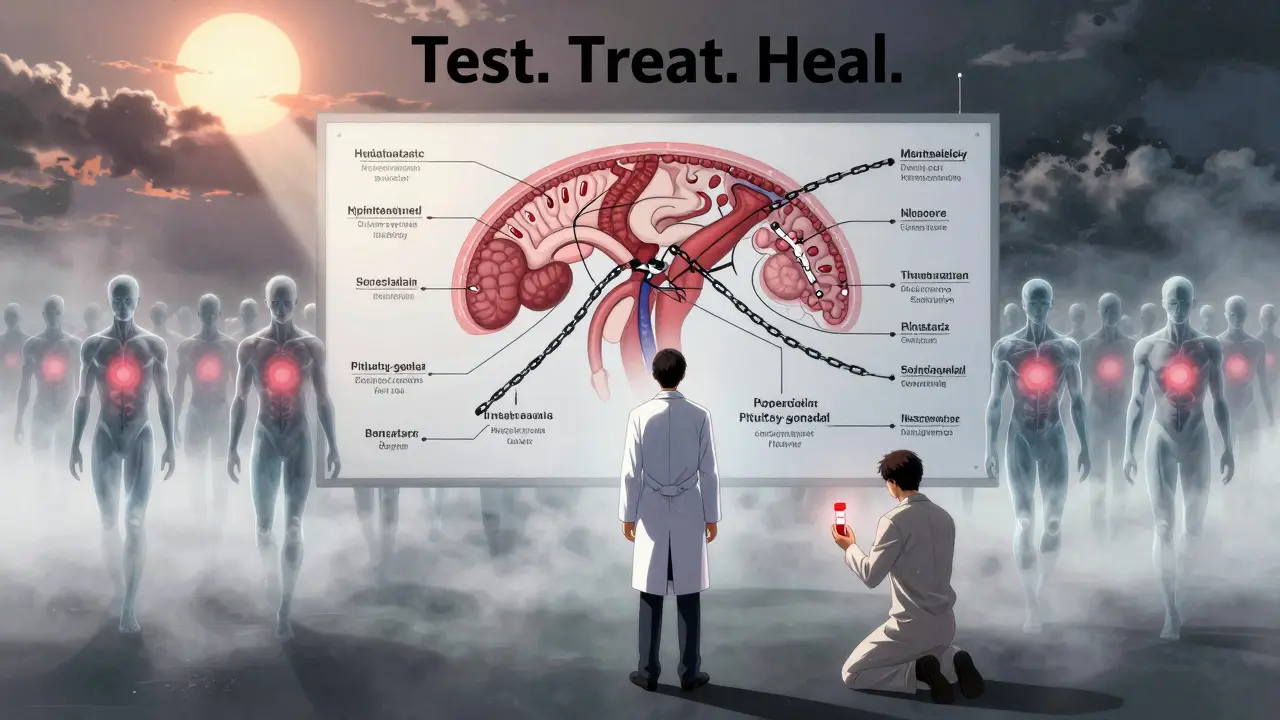
Opioid-Induced Androgen Deficiency, or OPIAD, is when long-term opioid use shuts down your body’s natural production of testosterone. It’s not rare. Studies show that between 50% and 90% of men on chronic opioid therapy have testosterone levels below normal. This happens because opioids interfere with the hypothalamic-pituitary-gonadal (HPG) axis-the system your body uses to make sex hormones. Opioids bind to receptors in the brain, dampening the signals that tell your testes to produce testosterone. The longer you’re on opioids, the worse it gets. Methadone and buprenorphine, often used for opioid use disorder, are especially potent at suppressing testosterone. One study found men on methadone had average testosterone levels of 245 ng/dL, while those on buprenorphine had 387 ng/dL. Normal levels? 300 to 1,000 ng/dL.
How Do You Know If You Have Low Testosterone From Opioids?
The symptoms don’t show up overnight. They creep in over 3 to 6 months. You might think you’re just getting older, stressed, or tired from pain-but it could be your hormones. Common signs include:
- Low libido or complete loss of interest in sex
- Erectile dysfunction (affects 60-75% of men with OPIAD)
- Chronic fatigue-even after sleeping
- Depressed mood or irritability
- Difficulty concentrating or brain fog
- Loss of muscle mass and increased belly fat
- Bones that break more easily
- Anemia (low red blood cell count)
One study using the Fatigue Severity Scale found opioid users scored 2.5 times higher than normal. Another found depression symptoms were 40% worse. These aren’t just "feeling down"-they’re measurable biological changes. If you’ve been on opioids for over a year and have two or more of these symptoms, it’s worth getting tested.
How Low Is Your Testosterone? The Numbers Matter
Testosterone levels drop with time. After 90 days of opioid use, levels fall 35-50% below baseline. After a year, they can be 50-75% lower. A 2021 meta-analysis of nearly 2,800 people showed opioid users had roughly half the testosterone of non-users. That’s not borderline-it’s clinical hypogonadism. The problem? Many doctors don’t test for it. The Endocrine Society recommends checking total and free testosterone in the morning (between 7 and 10 a.m.) because levels dip later in the day. Two low readings are needed for diagnosis. Without testing, OPIAD is invisible.
Treatment: Testosterone Replacement Therapy (TRT)
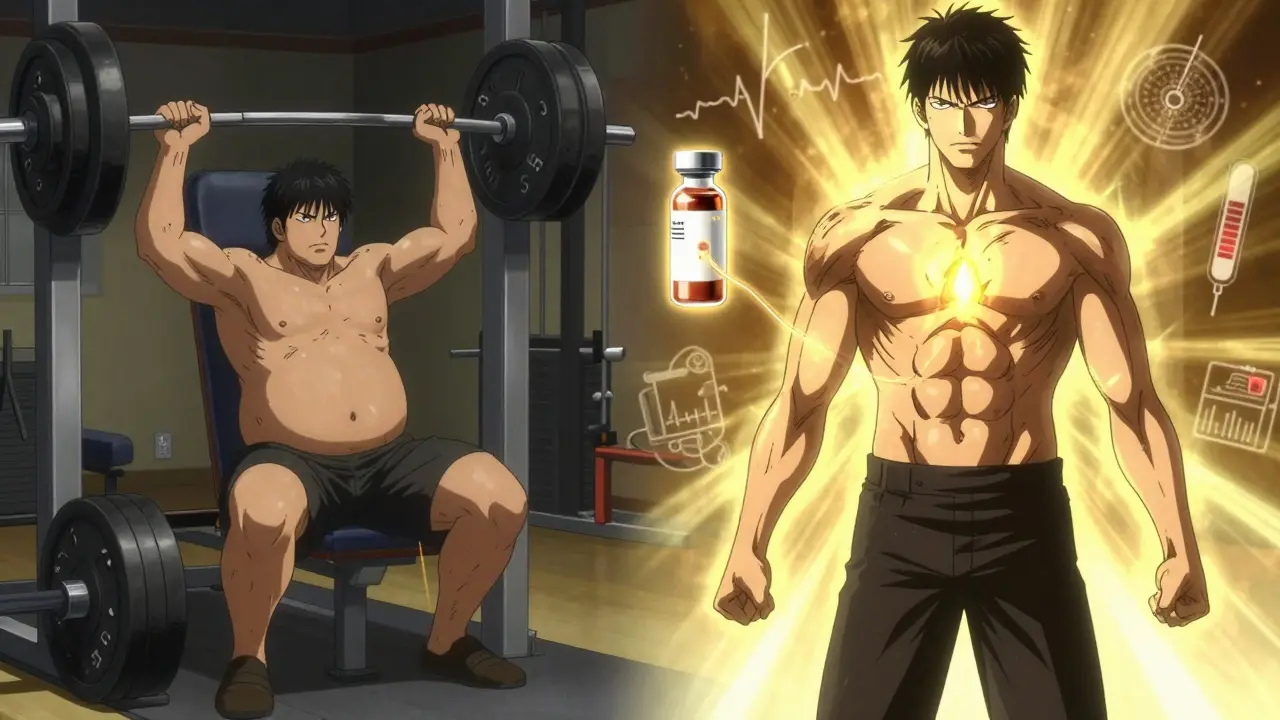
Testosterone replacement therapy works. Multiple studies confirm it. In one randomized trial, men on TRT while still taking opioids saw:
- Erectile function improve from 12.5 to 19.8 on the International Index of Erectile Function scale
- Lean muscle mass increase by 3.2 kg
- Fat mass drop by 2.1 kg
- Pain sensitivity decrease by 30%
And it’s not just about quality of life-it’s about survival. A major 2019 study in JAMA Network Open found men on TRT had:
- 49% lower risk of dying from any cause
- 42% lower risk of heart attack or stroke
- 35% lower risk of hip or femur fracture
- 26% lower risk of anemia
TRT isn’t one-size-fits-all. Options include:
- Injections: Testosterone cypionate or enanthate (100-200 mg every 1-2 weeks)
- Gels: 50-100 mg daily, applied to skin
- Patches: 5-7.5 mg daily, worn on skin
- Buccal tablets: 30 mg twice daily, stuck to the gum
Target levels? Between 350 and 750 ng/dL. Too low, and symptoms return. Too high, and side effects increase. Levels should be checked 3-6 months after starting, then annually.
The Risks of Testosterone Therapy
TRT isn’t risk-free. The FDA requires black box warnings for testosterone products due to potential cardiovascular risks. Side effects include:
- Polycythemia (thick blood)-happens in 15-20% of users
- Lower HDL ("good") cholesterol-drops 10-15 mg/dL
- Acne-25% of transdermal users
- Increased risk of blood clots and stroke-1.3 to 2 times higher
TRT is absolutely not for everyone. It’s contraindicated if you have prostate cancer, breast cancer, or a history of heart attack or stroke. Men over 50 need regular PSA tests every 6 months. Your doctor must weigh benefits against risks. If you’re on opioids and have low testosterone, TRT can be life-changing-but only if monitored carefully.
What About Natural Fixes?
Can you fix low testosterone without hormones? Partially. Lifestyle changes help-but they won’t reverse OPIAD on their own. Still, they’re essential support:
- Maintain a healthy weight: BMI under 25 is linked to 20-30% higher testosterone
- Exercise regularly: Three weekly resistance sessions boost testosterone 15-25%
- Sleep 7-9 hours: Poor sleep cuts testosterone by 20%
- Avoid smoking: Smokers have 15-20% lower levels
- Limit alcohol: More than 14 drinks a week drops testosterone 25%
- Manage blood sugar: Diabetics have 25-35% lower testosterone
These won’t replace TRT if your levels are severely low-but they’ll make TRT safer and more effective. They also help reduce opioid dependence over time by improving mood and energy naturally.
Why Isn’t This Screened More Often?
It’s a gap in care. Many clinicians don’t connect low energy or poor sex drive to opioids. Some think it’s "just aging." Others worry about promoting testosterone use. The VA Whole Health Library even warns that "low testosterone is being promoted by drug makers." But the evidence is clear: OPIAD is real, common, and treatable. The Pain Physician review states bluntly: "Screening for hypogonadism should be considered whenever long-term opioid prescribing is undertaken." Yet, most patients aren’t tested. If you’re on opioids, ask your doctor: "Could my symptoms be from low testosterone? Can we check my levels?"
What’s Next?
Opioid use is global. Over 58 million people used opioids in 2022. Millions are likely suffering from OPIAD without knowing it. Research is still catching up. We need better screening tools, clearer treatment guidelines, and more long-term safety data. But right now, the tools exist. The science is solid. The benefits are measurable. If you’ve been on opioids for months and feel like a shadow of yourself, don’t assume it’s just pain or aging. Get tested. Talk to your doctor. Your body might still be able to feel like yours again.
Can opioids cause low testosterone even if I’m not addicted?
Yes. Opioid-induced low testosterone isn’t tied to addiction-it’s tied to dosage and duration. Even people taking prescribed opioids for chronic pain, like after surgery or for arthritis, can develop OPIAD. It happens because opioids directly interfere with hormone signaling in the brain. Whether you’re using them as directed or not, long-term use (over 90 days) can suppress testosterone production.
How long does it take for testosterone to return after stopping opioids?
It varies. For some, testosterone rebounds within 3-6 months after stopping opioids. For others, especially those on high-dose or long-acting opioids like methadone, recovery can take a year or more. In some cases, the suppression may be permanent. That’s why testing before and after stopping opioids is critical. If levels don’t improve, testosterone replacement may be needed even after discontinuing opioids.
Is testosterone therapy safe for men with a history of heart problems?
It’s complicated. While testosterone therapy has been linked to a small increased risk of heart attack or stroke in some studies, it also reduces other major risks-like fractures and anemia-that can be deadly in opioid users. The 2019 JAMA study found TRT lowered overall mortality in long-term opioid users. If you have heart disease, TRT may still be an option, but only under close supervision by a cardiologist and endocrinologist. Blood pressure, cholesterol, and clotting factors must be monitored closely.
Can women on opioids also have low testosterone?
Yes, but it’s less studied. Women produce small amounts of testosterone in their ovaries and adrenal glands. Opioids can suppress this too, leading to low libido, fatigue, and mood changes. Some research suggests dehydroepiandrosterone (DHEA) supplementation may help, but evidence is limited. Women on long-term opioids should discuss symptoms with their doctor-even if they’re not thinking about testosterone, it could be a factor.
What tests should I ask my doctor for?
Ask for total testosterone and free testosterone, both measured in the morning (between 7-10 a.m.). Also request LH and FSH levels to determine if the problem is in the brain (hypogonadotropic) or the testes (primary). A complete blood count (CBC) to check for anemia, and a lipid panel to assess cholesterol, are also helpful. The Androgen Deficiency in Aging Males (ADAM) questionnaire can help identify symptoms before testing.
Does switching from methadone to buprenorphine help testosterone levels?
Yes. Studies show men who switch from methadone to buprenorphine often see a significant rise in testosterone. One study found average levels jumped from 245 ng/dL on methadone to 387 ng/dL on buprenorphine. This isn’t a cure-all, but for those on opioid agonist therapy, switching may be one of the most effective ways to improve hormone levels without adding hormones.

Milad Jawabra
March 4, 2026 AT 16:44Bro, I was on opioids for 3 years after a back surgery. Felt like a zombie. No sex drive, no energy, just… dead inside. Got tested, testosterone was at 180. Started TRT. Within 6 weeks, I was lifting again, sleeping better, and actually wanted to go out with friends. My wife cried. Not because I changed-because I came back.
Don’t ignore this. It’s not "just aging." It’s your body screaming for help.
Dean Jones
March 4, 2026 AT 20:57Look, I get that this is a real issue-OPIAD is legit, the data’s solid, and yeah, most docs are asleep at the wheel. But here’s the thing we don’t talk about: why are we treating the hormone deficiency like it’s a standalone problem when the root cause is still sitting there? You’re giving someone testosterone while they’re still on methadone? That’s like turning on the faucet while the pipe’s still leaking. The body doesn’t just need more T-it needs the suppression lifted. And that means tapering opioids, not just slapping on a patch. TRT helps symptoms, sure. But it doesn’t fix the neurological hijacking. We’re treating the shadow, not the light source.
And if you’re gonna do TRT, you need to monitor hematocrit like your life depends on it. I’ve seen guys go from 45 to 62 in 6 months. That’s not a stat-it’s a ticking time bomb.
Betsy Silverman
March 6, 2026 AT 05:18This post hit me hard. My dad’s been on long-term opioids for arthritis for over 8 years. He’s 68, and we thought his fatigue and mood swings were just "old age." But reading this… I finally understand why he stopped gardening, why he’d sit in silence for hours, why he didn’t want to hug me anymore.
I took him to his doctor last week. They tested him. His T was 210. He started TRT last month. He’s laughing again. He’s walking around the block. He asked me to help him fix the porch swing. I didn’t think I’d see that again.
Thank you for writing this. Not everyone knows how much this matters.
Ivan Viktor
March 6, 2026 AT 17:47So let me get this straight. You’re telling me if I take painkillers for my sciatica, I’m gonna turn into a limp, moody, fat guy with no dick energy? And the solution is… more hormones? Brilliant. Just what we need-another pill to fix the pill problem.
Next thing you know, they’ll be giving us testosterone shots just to get us to stop complaining about the weather.
Also, why is this even a thing? Did Big Pharma just decide to make men’s bodies into a feature, not a bug?
Matt Alexander
March 7, 2026 AT 10:33If you’re on opioids longer than 90 days and feel tired, weak, or like you’ve lost interest in life-get your testosterone checked. It’s simple. Blood test. Morning. Done. No guesswork. No fluff. If it’s low, talk to your doctor about TRT. It works. Not magic. Not hype. Science. And it can change your life. Seriously. Do it.
Stephen Vassilev
March 8, 2026 AT 04:22It is, however, a matter of grave concern that the medical establishment continues to overlook this condition as though it were a trivial side effect. The suppression of the HPG axis by exogenous opioids is a well-documented, physiologically inevitable consequence of prolonged administration-particularly in the context of methadone and buprenorphine regimens. The fact that the Endocrine Society has issued formal recommendations, yet clinical practice remains grossly inconsistent, suggests a systemic failure of medical ethics and education. Moreover, the promotion of TRT as a "solution" without addressing the underlying dependency paradigm is, frankly, a form of pharmaceutical band-aiding. We are not treating patients-we are managing symptoms for institutional convenience. This is not medicine. This is commodified survival.
Helen Brown
March 8, 2026 AT 05:12Wait. So you’re saying if you’re on pain meds, your body stops making testosterone… and doctors don’t even check? What if this is all just a scam? What if they want us to stay on opioids so we need TRT so we keep going back? What if the whole system is built to keep us dependent? I’ve read about this before. They’re not telling us the truth. I’m not taking TRT. I’m done with all this. I’m going off opioids cold turkey. Screw it.
John Cyrus
March 9, 2026 AT 22:19TRT? Seriously? You’re telling men to take steroids just because they’re on painkillers? What’s next? Testosterone for people who watch too much Netflix? This is why America’s falling apart. Everyone wants a quick fix instead of fixing their lifestyle. You don’t need hormones-you need to get off the couch, stop eating junk, and sleep like a human. This post is just another excuse to be lazy and take more drugs.
Sharon Lammas
March 11, 2026 AT 05:37I’ve been reading this and thinking about my cousin. She’s on opioids for fibromyalgia. She’s a woman. She never talks about how tired she is, or how she doesn’t feel like herself anymore. I never thought about testosterone for her. But now I wonder-maybe she’s got the same thing, just quieter. Maybe she’s not losing her sex drive because she’s "not interested"-but because her body’s been silenced.
I’m going to ask her. Just to check. Not to fix. Just to see if she’s still in there.
Aisling Maguire
March 12, 2026 AT 21:28My mate switched from methadone to buprenorphine last year. Said his libido came back like a ghost showing up at a party. No TRT. Just a switch. Wild, right? Also, he stopped drinking and started lifting. Now he’s got a six-pack and a sense of humor again. Who knew the answer wasn’t more drugs-but less bad ones?
Diane Croft
March 13, 2026 AT 20:27You are NOT alone. This is fixable. Your body still has the power to heal. Ask for the test. Demand the answer. You deserve to feel like yourself again. Start today. One step. One call. One blood test. You got this.
tatiana verdesoto
March 14, 2026 AT 16:02I’ve been on buprenorphine for 4 years for OUD. I didn’t realize how much my energy had dropped until I started hiking again last summer. My T was 310-barely in range. Started TRT. Now I’m stronger than I’ve been since I was 25. It’s not about being "addicted" to hormones. It’s about being alive again. This isn’t cheating. It’s recovery.
Raman Kapri
March 14, 2026 AT 20:50It is my duty to point out that the claim that 50-90% of opioid users experience hypogonadism is statistically misleading. The studies cited are often small, observational, and fail to control for comorbidities such as obesity, sleep apnea, and depression-all of which independently suppress testosterone. The correlation does not imply causation. Furthermore, the JAMA study on mortality reduction does not account for selection bias-those who received TRT were likely healthier, more compliant, and had better access to care. This entire narrative is dangerously oversimplified and risks encouraging unnecessary medicalization of normal physiological variation.