

When you notice you're asking people to repeat themselves more often, or you struggle to hear conversations in noisy rooms, it's not just aging-it might be hearing loss. The first step to understanding what's going on is audiometry testing. This isn't a simple ear check. It's a precise, science-backed process that measures exactly how well you hear different sounds, using decibels (dB) as the universal scale. If you've ever wondered how audiologists know whether you have mild hearing loss or something more serious, this is how they find out.
What Happens During an Audiometry Test?
You sit in a quiet room, wear headphones, and press a button every time you hear a tone. Sounds simple, right? But there's a method behind it. The test starts at 1000 Hz-a mid-range frequency-and plays a tone at 40 dB. If you hear it, the audiologist lowers the volume by 10 dB. You keep responding until you stop hearing it. Then they go back up in 5 dB steps until you hear it again. That’s your threshold-the softest sound you can detect at that frequency, 50% of the time.
This process repeats across eight key frequencies: 250 Hz, 500 Hz, 1000 Hz, 2000 Hz, 4000 Hz, and 8000 Hz. Each one maps to a different part of speech. Lower frequencies like 250 Hz help you hear vowels. Higher ones like 4000 Hz are where consonants like 's', 't', and 'k' live. That’s why many people with hearing loss say they can hear people talking but can’t understand what they’re saying-they’re missing the high-pitched sounds that carry meaning.
Most tests also include bone conduction. A small device is placed behind your ear, on the mastoid bone. Instead of sending sound through your ear canal, it vibrates directly into your inner ear. If your air conduction (through headphones) is worse than your bone conduction, it means something’s blocking sound in your outer or middle ear-like wax, fluid, or a damaged eardrum. That’s called a conductive hearing loss. If both are equally poor, the issue is likely in your inner ear or auditory nerve-a sensorineural loss.
Decibel Levels Explained: What Do the Numbers Mean?
The results are plotted on an audiogram, a graph that shows hearing sensitivity across frequencies. The vertical axis is volume in decibels (dB HL), and the horizontal axis is frequency in hertz (Hz). Zero dB HL doesn’t mean silence-it’s the average hearing level for healthy young adults. Anything below 25 dB HL is considered normal hearing.
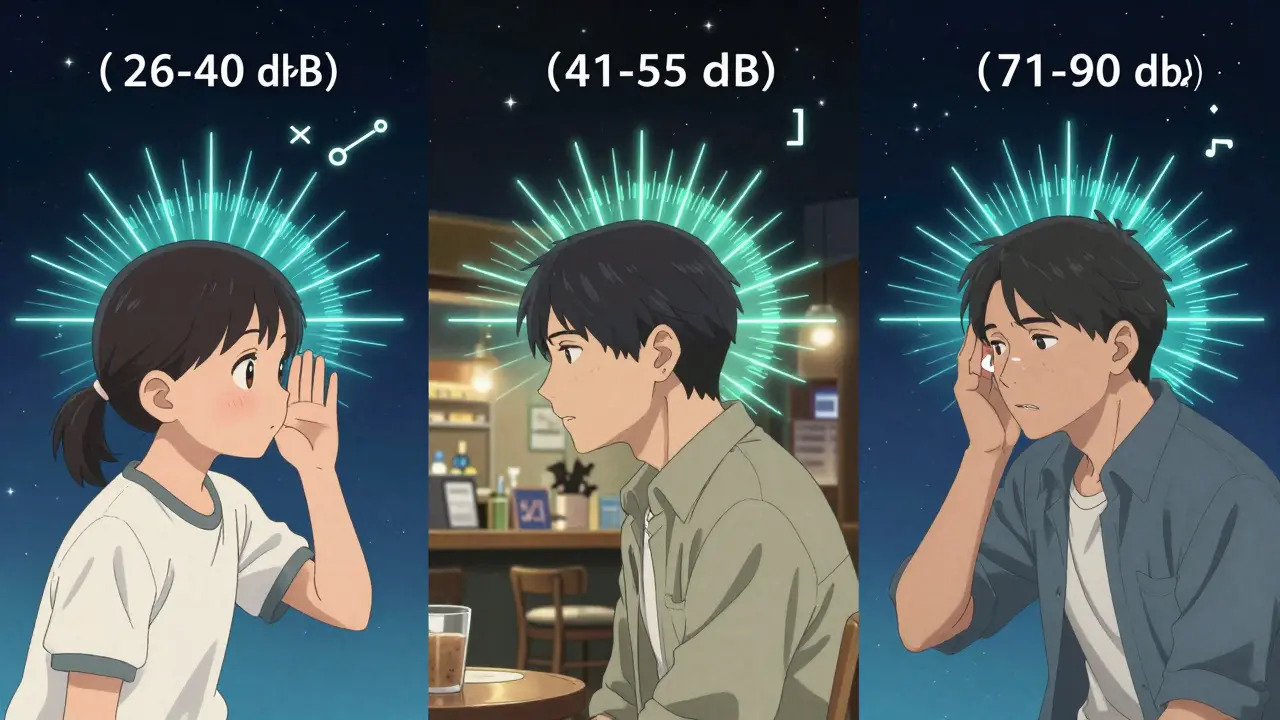
- 26-40 dB: Mild hearing loss. You might miss soft speech or struggle in noisy places.
- 41-55 dB: Moderate hearing loss. Conversations become difficult, especially with background noise.
- 56-70 dB: Moderately severe hearing loss. You need people to speak loudly or clearly.
- 71-90 dB: Severe hearing loss. You hear only very loud sounds, like shouting or a lawnmower.
- 91+ dB: Profound hearing loss. You may only feel vibrations.
For example, a 58-year-old man in Sydney with a 45 dB loss at 2000 Hz would have trouble hearing words like "think" or "fish." He might not realize it’s his hearing-he just thinks people mumble. That’s why audiometry matters: it turns vague complaints into clear data.
Beyond Pure Tones: Speech and Middle Ear Tests
Audiometry isn’t just about tones. Two other critical tests are speech reception threshold (SRT) and word recognition.
SRT checks the quietest level at which you can repeat 50% of two-syllable words like "baseball" or "hotdog." The result should match your average pure-tone threshold at 500, 1000, and 2000 Hz-within ±10 dB. If it’s way off, something else is going on. Maybe your brain isn’t processing sound properly, even if your ears are fine.
Word recognition (or speech discrimination) tests how well you understand words at a comfortable volume. A score below 80% is a red flag. Someone with normal hearing might get 95%. If you score 60%, it suggests damage to the inner ear or auditory nerve. This is especially important for people considering hearing aids. If your brain can’t distinguish words, even the best hearing aid won’t help much.
Tympanometry adds another layer. A small probe seals your ear canal and changes air pressure. It measures how well your eardrum moves. A flat line (Type B tympanogram) means fluid is trapped behind your eardrum-common in kids with ear infections. A normal result (Type A) means your middle ear is functioning properly. This test takes less than a minute and helps rule out treatable causes of hearing loss.

Who Needs Audiometry Testing?
You don’t need to wait until you’re struggling to get tested. The American Academy of Audiology recommends a baseline hearing test at age 50, then every three years after that. But certain situations call for earlier testing:
- Regular exposure to loud noise (construction, music, machinery)
- Family history of hearing loss
- Diabetes, heart disease, or high blood pressure-conditions linked to inner ear damage
- Medications known to affect hearing (some antibiotics, chemotherapy drugs)
- Children who don’t respond to their name or seem to ignore speech
Newborns are screened before leaving the hospital. If they fail, a full diagnostic audiometry test must happen by three months of age. Early intervention can prevent lifelong speech and learning delays.
What About Tele-Audiology and AI?
Since 2020, remote hearing tests have become more common. Devices like the KUDUwave allow you to do a basic audiometry test at home with a calibrated headset and internet connection. But they have limits. They can’t reliably test below 25 dB HL, and they can’t do bone conduction or speech discrimination. They’re great for screening, not diagnosis.
Artificial intelligence is starting to help too. Software from companies like Otometrics can analyze your audiogram and flag patterns-like a typical noise-induced notch at 4000 Hz or a conductive loss from fluid buildup. In trials, it correctly identified 92% of conductive losses. But it doesn’t replace the audiologist. It just helps them work faster and spot things they might miss.
Common Misconceptions and Pitfalls
Many people think hearing tests are just about volume. They’re not. Two people can have the same decibel loss but very different experiences. One might hear fine in quiet rooms but struggle in restaurants. The other might hear everything but can’t follow conversations. That’s why speech testing matters.
Another myth: if you don’t hear a tone, you’re just not trying hard enough. That’s not true. Fatigue, anxiety, or cognitive load can affect your responses. That’s why audiologists use the modified Hughson-Westlake method-it’s designed to account for human variability. They don’t just play tones. They adjust, confirm, and verify.
And masking? It’s often skipped, but it’s critical. If one ear is much better than the other, the good ear can hear the tone meant for the bad ear. That gives false results. Proper masking-playing noise in the good ear-ensures the test is accurate. About 12% of tests fail due to poor masking, according to Mayo Clinic data.
What Happens After the Test?
A good audiologist doesn’t just hand you a graph. They explain it. They show you where you’re losing hearing, why it matters, and what options exist. If you have a conductive loss, they might refer you to an ENT for wax removal or surgery. If it’s sensorineural, they’ll talk about hearing aids, assistive devices, or even cochlear implants for severe cases.
They also help you understand your audiogram. Circles mean right ear air conduction. X’s mean left ear air conduction. Brackets are right bone conduction. Less-than signs are left bone conduction. These aren’t just symbols-they’re the language of hearing health.
And if you’re told you don’t need hearing aids? That’s okay. Some losses are mild and don’t require intervention. But you should still get checked every few years. Hearing loss can worsen silently.
Why This Matters
Hearing loss affects 48 million Americans and millions more worldwide. It’s linked to social isolation, depression, and even cognitive decline. Yet, fewer than 20% of people who could benefit from hearing aids actually use them. Why? Often because they don’t understand their hearing loss. Audiometry testing changes that. It turns confusion into clarity. It gives you a map-not just of your ears, but of your communication world.
Whether you’re 25 or 75, if you’ve ever thought, "I think I need to get my hearing checked," you’re right. Don’t wait until you’re missing half the conversation. Get tested. Know your numbers. Your ears-and your relationships-will thank you.



Jesse Hall
March 23, 2026 AT 16:50Donna Fogelsong
March 24, 2026 AT 00:24Sean Bechtelheimer
March 24, 2026 AT 18:05Seth Eugenne
March 26, 2026 AT 08:23Caroline Dennis
March 26, 2026 AT 21:09Raphael Schwartz
March 27, 2026 AT 08:11winnipeg whitegloves
March 28, 2026 AT 11:24Marissa Staples
March 30, 2026 AT 05:17Rachele Tycksen
March 31, 2026 AT 03:19Grace Kusta Nasralla
April 2, 2026 AT 01:36