
Every year, millions of people in the U.S. take supplements alongside prescription drugs-sometimes without realizing the risks. You might be popping a multivitamin, fish oil, or St. John’s wort because you think it’s harmless. But here’s the truth: supplement labels don’t tell you the full story. Unlike your blood pressure pill or antibiotic, supplement makers aren’t required to warn you about dangerous interactions. And that gap can land you in the hospital.
What’s on a Supplement Label (and What’s Missing)
Look at the back of your supplement bottle. You’ll see a box labeled Supplement Facts. That’s the only part the FDA actually requires. Inside, you’ll find:
- Serving size
- Amount per serving of each ingredient
- Percent Daily Value (if established)
- Full list of ingredients
- Allergen warnings (for milk, soy, nuts, etc.)
But here’s the problem: there’s no section for drug interactions. Not one. Not even a tiny footnote. That’s because the Dietary Supplement Health and Education Act (DSHEA) of 1994 lets supplement makers skip safety testing before selling. The FDA can’t force them to prove their product won’t interfere with your meds. So unless a company chooses to add a warning-voluntarily-it won’t be there.
A 2021 FDA review of 500 top-selling supplements found only 12.7% included any drug interaction warning. Compare that to prescription drugs, where 97.3% list interactions. Or OTC painkillers-94% do. You’re expected to know this on your own.
How Drug Labels Work (So You Can Spot the Difference)
Your prescription or OTC drug label follows a strict format called Drug Facts. It’s designed to be clear and consistent. The Warnings section is where the real safety info lives. It tells you:
- When to avoid the drug (e.g., "Do not use if you have liver disease")
- When to call your doctor (e.g., "Talk to your doctor if you’re taking blood thinners")
- Specific drug interactions (e.g., "May reduce effectiveness of warfarin")
Some drugs even have a Black Box Warning-the FDA’s strongest alert. You’ll see it on medications like warfarin, digoxin, and certain antidepressants. These are drugs that can kill you if mixed with the wrong supplement.
Meanwhile, your turmeric capsule? No box. No warning. Just a list of ingredients. And if it says "proprietary blend," you’re in the dark. That means the manufacturer won’t tell you how much of each ingredient is in there. One study found 38% of supplements use this trick to hide low doses of powerful herbs.
Supplements That Can Kill Your Meds (Real Examples)
Let’s get specific. These aren’t hypothetical risks. These are documented, real-world dangers:
- St. John’s wort and digoxin: This herbal antidepressant can drop digoxin levels in your blood by 26%. That means your heart failure meds stop working. People have ended up in the ER with dangerously slow heart rates.
- Vitamin K and warfarin: Warfarin prevents clots. Vitamin K helps your blood clot. If you take green tea extract or a multivitamin with high vitamin K, warfarin’s effect can drop by 30-50%. That’s not a minor tweak-it’s a life-threatening change.
- CoQ10 and warfarin: Even though CoQ10 is sold as a heart health supplement, it can shorten your prothrombin time by 15-25%, making warfarin less effective. The FDA flagged this in a 2023 safety alert.
- Milk thistle and metformin: People with diabetes take metformin to control blood sugar. Milk thistle can drop it too low. One patient reported a blood glucose level of 42 mg/dL-dangerously low. He didn’t know the supplement could do that.
- Vitamin C (over 1,000 mg/day) and antiretrovirals: High-dose vitamin C can alter stomach pH and reduce the absorption of HIV meds by 22%. That’s not just a theory-it’s from a 2023 pharmacy analysis.
And here’s the kicker: none of these warnings are required on the supplement bottle.
How to Protect Yourself (Step by Step)
You can’t rely on labels. So you have to take control. Here’s how:
- Write down everything you take. Not just pills-vitamins, herbs, teas, powders, even topical creams. Include dosages and how often you take them.
- Take a photo of every supplement label. Keep them in your phone. When you see your doctor or pharmacist, show them. Don’t say, "I take this thing." Show them the bottle.
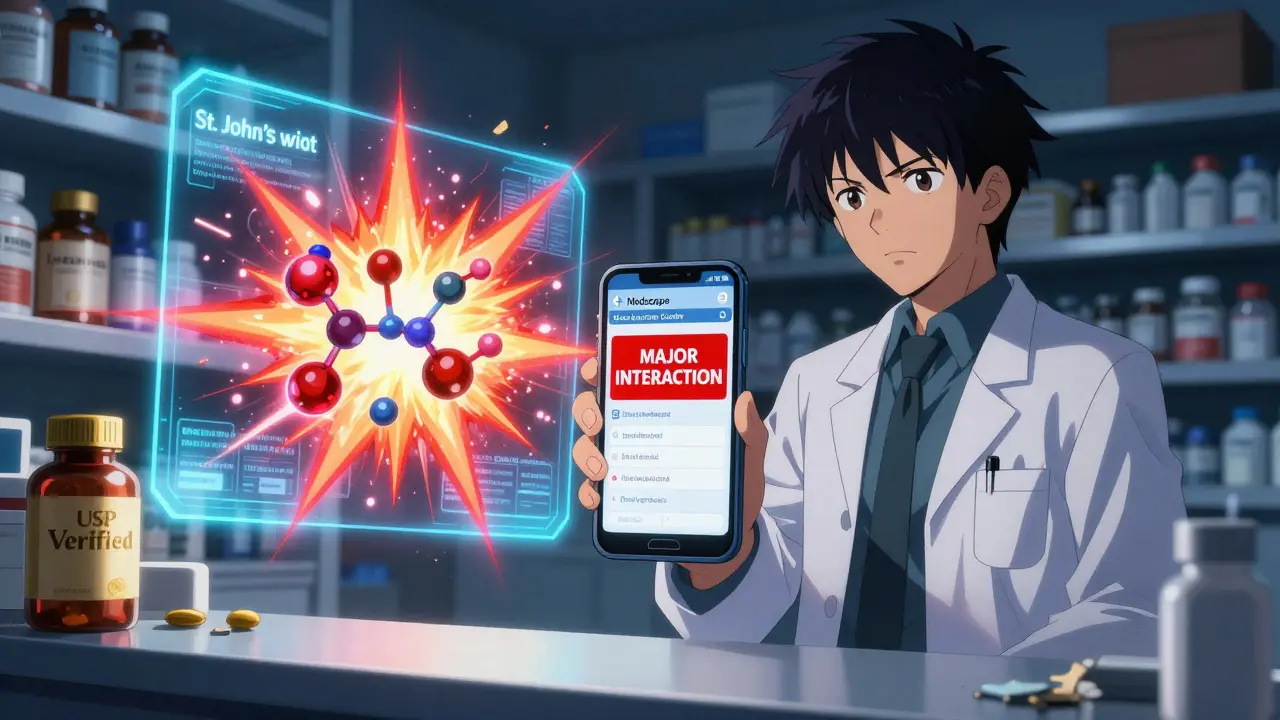
- Use free tools. Go to Medscape Drug Interaction Checker (free, no login needed). Type in your prescription and your supplement. It checks over 24,000 drug pairs. If it says "major interaction," stop and call your doctor.
- Ask your pharmacist. Not your doctor. Pharmacists are the experts on drug interactions. They see hundreds of combinations daily. Bring your list every time you fill a new prescription.
- Don’t trust "natural". Red yeast rice contains monacolin K-the same active ingredient as lovastatin, a prescription statin. Taking it with other statins can cause muscle damage. "Natural" doesn’t mean safe. It means unregulated.
A 2023 University of Florida study showed that people who spent just 15 minutes learning how to read labels reduced their risk of dangerous interactions by 63%. That’s not magic. That’s information.
The Bigger Problem: Who’s Watching?
The supplement industry made $53.1 billion in 2023. Seven in ten Americans take at least one supplement. But the FDA’s Office of Dietary Supplement Programs? It runs on a $4.7 million budget. That’s 0.03% of the FDA’s total funding. They can’t inspect every product. They can’t force recalls. In 2023, they found over 1,200 mislabeled supplements-but only 28% led to recalls.
And the law hasn’t changed. The Dietary Supplement Listing Act of 2022, which would have forced companies to notify the FDA before selling, died in Congress. So we’re stuck with a system where safety is optional.
Some brands do better. Look for the USP Verified mark. That means an independent lab tested the product for purity, strength, and accurate labeling. Only 18% of supplements carry it. But those that do? 92% accurate. The rest? As low as 67%.

What’s Changing? (And What’s Not)
The FDA released draft guidance in March 2024 suggesting supplement makers voluntarily add interaction warnings. That’s it. No rules. No penalties. Just a suggestion.
The American Medical Association now recommends doctors ask patients about supplements during annual checkups. That’s good. But most patients don’t think to mention them. A 2023 survey found 47% kept using supplements despite being on meds-because they never saw a warning.
Some companies are testing QR codes on labels. Scan it, and you get a live interaction report. It’s a start. But until the law changes, it’s up to you.
Bottom Line: Your Health Is Your Responsibility
You don’t need to stop taking supplements. But you do need to stop assuming they’re safe with your meds. The system isn’t broken-it was designed this way. Supplements are treated like food, not medicine. That’s why labels don’t warn you.
Here’s what you do:
- Know what’s in your bottle
- Check interactions with Medscape or your pharmacist
- Bring your label to every appointment
- Choose USP-certified when you can
- Question "natural"
If you’re on blood thinners, heart meds, diabetes drugs, or antidepressants-this isn’t optional. One wrong combo can send you to the ER. Don’t wait for a warning label. Make your own.
Do supplement labels have to list drug interactions?
No. Under U.S. law (DSHEA), supplement manufacturers are not required to include drug interaction warnings on their labels. Only prescription and OTC drugs must list them. This is a major safety gap-only about 12.7% of popular supplements voluntarily include these warnings.
What should I do if my supplement doesn’t warn about interactions?
Don’t assume it’s safe. Use the free Medscape Drug Interaction Checker or consult your pharmacist. Bring a photo of the supplement label to your doctor or pharmacist and ask: "Can this interact with my current medications?" Never start a new supplement without checking.
Are "natural" supplements safer than drugs?
No. "Natural" doesn’t mean safe or non-interacting. Red yeast rice contains the same active ingredient as the prescription statin lovastatin. St. John’s wort can make heart and antidepressant drugs ineffective. Many herbal supplements are potent and can cause serious side effects when mixed with medications.
What’s a proprietary blend, and why should I care?
A proprietary blend hides the exact amount of each ingredient. The label might say "proprietary blend: 500 mg," but you won’t know how much of each herb or compound is inside. This makes it impossible to assess interaction risks. Over half of protein and energy supplements use this tactic to obscure low doses of powerful ingredients.
Should I stop taking supplements if I’m on medication?
Not necessarily-but you must check each one. Some supplements, like vitamin D or calcium, are safe with most meds. Others, like St. John’s wort or vitamin K, can be dangerous. Always consult your pharmacist or doctor before starting or stopping any supplement while on prescription drugs.
Is there a way to know if my supplement is even reliable?
Yes. Look for the USP Verified mark. It means an independent lab tested the product for accurate ingredients, purity, and dissolution. USP-certified supplements are 92% accurate in labeling. Non-certified ones are only about 67% accurate. That’s a big difference when you’re mixing them with life-saving drugs.
What to Do Next
Right now, grab your phone. Open your Notes app. Write down every supplement you take-name, dose, frequency. Then take a photo of each label. Next time you see your pharmacist, hand them your list and photos. Ask: "Which of these could interfere with my meds?"
That’s it. No magic. No expensive apps. Just one conversation that could save your life.

jeremy carroll
December 16, 2025 AT 06:01Alexis Wright
December 17, 2025 AT 10:21Sinéad Griffin
December 18, 2025 AT 21:02Edward Stevens
December 19, 2025 AT 12:59Natalie Koeber
December 20, 2025 AT 12:36Rulich Pretorius
December 22, 2025 AT 11:37Thomas Anderson
December 24, 2025 AT 01:15Dwayne hiers
December 25, 2025 AT 09:51Jonny Moran
December 26, 2025 AT 05:42