

When you’re managing a chronic condition like rheumatoid arthritis, Crohn’s disease, or cancer, the cost of treatment can be just as stressful as the illness itself. Biologic drugs - the powerful, protein-based therapies that target specific parts of the immune system - can cost over $20,000 a year. That’s why biosimilars matter. They’re not generics. They’re not copies. They’re highly similar versions of these expensive biologics, and the evidence shows they work just as well.
What Exactly Is a Biosimilar?
A biosimilar isn’t like a generic pill. You can’t just mix chemicals in a lab and get the same result. Biologics are made from living cells - think yeast, bacteria, or hamster ovary cells - and are incredibly complex. Even tiny changes in how they’re made can affect how they behave in the body. A biosimilar is built to match the original biologic as closely as possible, using the same cell lines and manufacturing processes. But it doesn’t need to be identical. It just needs to be highly similar - with no clinically meaningful differences in safety, purity, or potency.
The FDA and EMA don’t just approve these based on theory. They require over 200 analytical tests comparing the biosimilar to the original. That includes checking the protein structure, how it binds to targets, how stable it is, and how it behaves in the body. Then comes pharmacokinetic testing - measuring how fast it enters the bloodstream and how long it lasts. Finally, clinical studies in hundreds of patients confirm it works the same way. For some biosimilars, even that last step is skipped if the analytical data is strong enough.
Do Biosimilars Work as Well in Real Patients?
Let’s cut through the noise. People worry: What if my disease flares up after switching? What if I get more side effects? The data says no.
A 2022 meta-analysis of 1,711 patients across six cancer types - including breast cancer, lymphoma, and lung cancer - found biosimilars matched the original drugs exactly. The overall response rates? Almost identical. For trastuzumab (used in HER2+ breast cancer), the biosimilar had a 1.01 response rate compared to the original. That’s not a difference. That’s noise.
In rheumatology, the numbers are even clearer. A study of 3,450 patients with rheumatoid arthritis across 12 European hospitals tracked how long people stayed on their drug - called drug survival. The biosimilar (ABP501) and the original (adalimumab) both had drug survival rates around 82%. The difference? Statistically meaningless. A Canadian study of 1,200 IBD patients on infliximab biosimilars found no change in disease activity, hospitalizations, or flare rates over two years.
And it’s not just clinical trials. Real-world data from the NHS in the UK tracked over 12,000 patients who switched from rituximab to its biosimilar. No spike in infections. No rise in adverse events. On PatientsLikeMe, 87% of users said their symptom control stayed the same after switching from Humira to its biosimilar, Amjevita. Only 2% reported worse symptoms - and even then, doctors couldn’t confirm it was the drug.
Why Do Some Doctors Still Hesitate?
Even with all this evidence, 38% of U.S. physicians still have doubts, according to a 2021 survey. Why? It’s not science. It’s perception.
Many doctors trained on the original biologics. They’ve seen patients respond well. They know the side effect profile. Switching feels risky, even when the data says otherwise. Some are influenced by marketing from the original manufacturers, who still push the narrative that biosimilars are "second-rate." Others worry about immunogenicity - the chance that the body will react to the biosimilar as a foreign substance. But after more than a decade of use and over half a million patient-years of real-world data, there’s no consistent signal of higher immune reactions.
One 2022 JAMA editorial raised a valid point: long-term immunogenicity data beyond five years is still limited. That’s true. But we’ve had biosimilars in Europe since 2006. We’ve had them in the U.S. since 2015. Millions of doses have been given. If there was a hidden risk, we’d see it by now.

Cost Savings Are Real - and Massive
The biggest win? Price. Biosimilars typically cost 15-30% less in the U.S. and up to 85% less in Europe. In Australia, where Medicare subsidizes biologics, biosimilars have cut out-of-pocket costs for patients by nearly half.
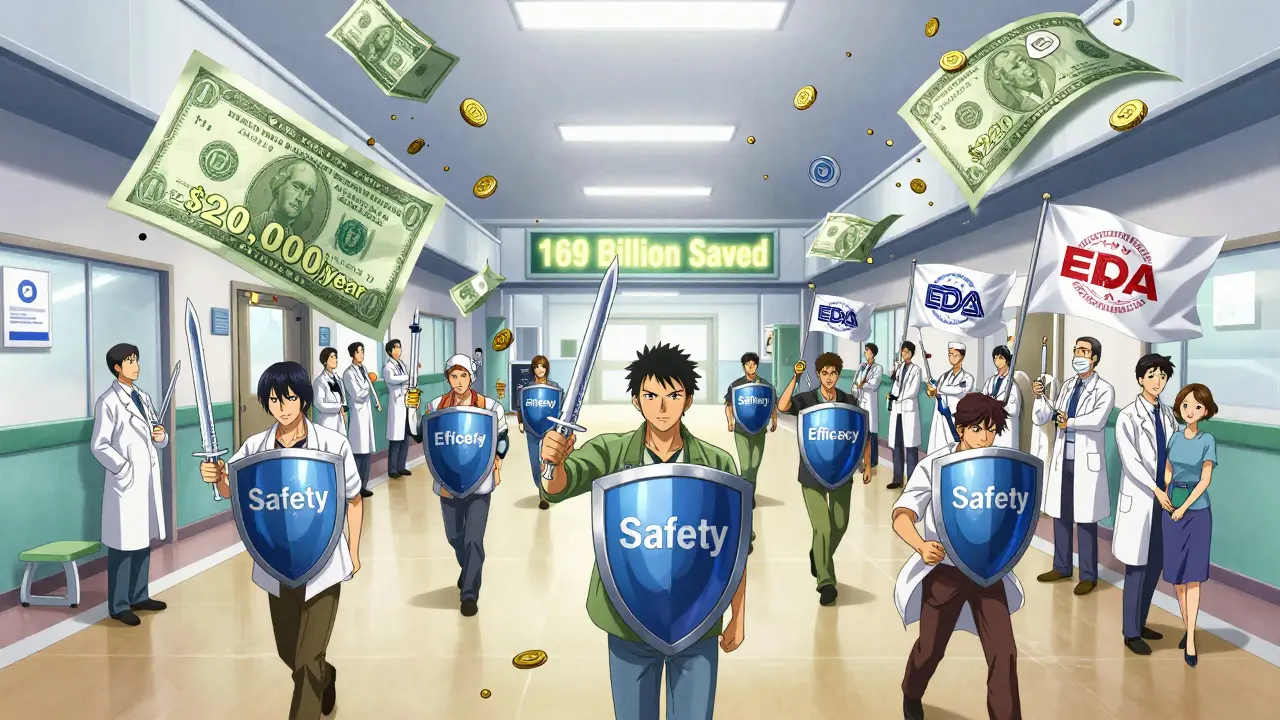
The Congressional Budget Office estimates biosimilars will save the U.S. healthcare system $169 billion over the next decade. Medicare Part B alone saved $1.3 billion in one year because of biosimilar competition. That’s not just a win for insurers. It’s a win for patients who can’t afford $20,000 a year. It’s a win for hospitals that can treat more people without running out of budget.
And it’s not just about one drug. When one biosimilar enters the market, it pressures the original drug to lower its price. When a second biosimilar comes in, prices drop again. It’s basic economics - and it’s working.
Switching Isn’t a Risk - It’s Routine
Some patients fear switching from the original to a biosimilar. But the process isn’t chaotic. It’s structured.
Hospitals and clinics use clear protocols: a one-time switch, followed by a few months of monitoring. Blood tests, symptom logs, and follow-up visits. In 15 U.S. health systems that implemented biosimilar adoption programs, 98% reached over 75% usage within a year. Patient refusal dropped from 22% to just 5% after they got clear, simple education materials.
Even switching from one biosimilar to another? That works too. A 2023 study in Clinical Rheumatology found patients who switched between two different adalimumab biosimilars had the same drug retention rate as those who stayed on one. No loss of effectiveness. No increase in side effects.
What About Oncology? Isn’t That Too Risky?
It’s a common concern. Cancer patients are often told: "Don’t mess with what works." But the data says otherwise.
The NOR-SWITCH trial - a randomized, double-blind study of 480 patients with various cancers - compared the original rituximab to its biosimilar. The response rate? 72.9% vs. 69.3%. The difference? Not statistically significant. No extra infections. No more fatigue. No more dropouts.
In fact, biosimilars are now standard of care in many European oncology centers. In the U.S., uptake is slower - only 31% of oncologists report using them routinely - but that’s changing fast. The FDA recently proposed eliminating clinical efficacy trials for biosimilars if analytical and PK data are strong enough. That’s a sign they’re confident.
Who Makes These Drugs?
It’s not just one company. Sandoz, Samsung Bioepis, Amgen, and Pfizer are the big players. Sandoz alone made $2.1 billion from biosimilars in 2023. These aren’t small-time players. They’re global pharmaceutical companies with the same quality controls as the original manufacturers.
And the pipeline is full. Over 120 biosimilars are in development worldwide. We’re just getting started. By 2030, the global market could hit $38.5 billion.
Bottom Line: The Evidence Is In
Biosimilars aren’t a gamble. They’re a proven alternative. Over 100 approved globally. Half a million patient-years of real-world data. No meaningful difference in safety or effectiveness. And billions in savings.
If you’re on a biologic and your doctor suggests switching to a biosimilar, don’t panic. Ask for the data. Ask about the studies. Ask about your own experience. You’re not losing anything - you’re gaining access to the same treatment at a fraction of the cost.
And if you’re a provider? The evidence is clear. Use biosimilars. They work. They’re safe. And they’re the smartest move for your patients - and your system.
Are biosimilars the same as generics?
No. Generics are chemically identical copies of small-molecule drugs - like aspirin or metformin. Biosimilars are copies of complex biologic drugs made from living cells. They’re highly similar, but not identical. That’s why they require much more testing than generics.
Can I switch from a biologic to a biosimilar safely?
Yes. Multiple studies, including randomized trials and real-world data from the NHS and U.S. health systems, show switching is safe. Most patients experience no change in symptoms or side effects. Doctors typically monitor patients for 1-3 months after the switch, but serious issues are extremely rare.
Do biosimilars cause more side effects?
No. Studies tracking over 500,000 patients show no increase in adverse events with biosimilars compared to the original biologics. The most common side effects - like injection site reactions or fatigue - are identical in type and frequency.
Why are biosimilars cheaper if they’re so similar?
Because they don’t need to repeat the full clinical trials that the original drug did. The original manufacturer spent billions on discovery, early trials, and regulatory approval. Biosimilar makers build on that data, focusing on proving similarity. This cuts development costs dramatically - which translates to lower prices for patients and insurers.
Are biosimilars approved in Australia?
Yes. The Therapeutic Goods Administration (TGA) approves biosimilars using the same rigorous standards as the FDA and EMA. Several biosimilars - including infliximab, rituximab, and etanercept - are listed on the PBS (Pharmaceutical Benefits Scheme) and are widely used in Australian hospitals and clinics.

Brandon Osborne
February 8, 2026 AT 14:04Let me tell you something - I switched my mom from Humira to the biosimilar last year because we couldn’t afford the copay anymore. She cried for three days thinking she was being ‘downgraded.’ Then she got her first injection and said, ‘I feel exactly the same.’ No flare-ups. No weird rashes. No drama. Just cheaper. And now she’s the one telling everyone at her support group to do it. If you’re scared, you’re not being careful - you’re being manipulated by pharma ads.
Stop acting like biosimilars are some kind of gamble. They’re not. They’re science. And if your doctor won’t prescribe it? Find a new one.
Lyle Whyatt
February 10, 2026 AT 05:07As an Aussie who’s been on infliximab biosimilars since 2019, I can say with 100% certainty that this isn’t some theoretical debate - it’s daily life. My hospital here doesn’t even *offer* the original anymore unless you’ve got a documented allergy or a history of losing response. And honestly? That’s the smartest thing they’ve done.
We’ve got data from over 8,000 patients in the Australian Rheumatology Database showing zero difference in disease control, hospital admissions, or infection rates. The cost savings? Yeah, they’re massive. The PBS saved over $120 million last year just on infliximab biosimilars alone. That money didn’t vanish - it went into hiring more nurses, funding more clinics, and reducing wait times for joint replacements. This isn’t just about drugs - it’s about equity.
And before anyone says ‘but what about long-term immunogenicity?’ - we’ve had these in use here for nearly a decade. If there was a hidden risk, we’d be seeing it in the registry data. We’re not. So stop talking theory. Look at the real-world outcomes. They’re clear.
MANI V
February 10, 2026 AT 12:35People are so naive. Biosimilars are just another way for Big Pharma to make money under a different name. You think Sandoz and Pfizer are doing this out of the goodness of their hearts? Please. They’re cutting corners. They’re not doing full trials. They’re relying on loopholes. And now you’re all drinking the Kool-Aid like it’s some miracle.
I’ve seen patients get worse after switching. Not because of the drug - because of the *fear*. The anxiety. The stress. That’s not in the studies. That’s real. And no amount of statistical noise will erase the fact that some people are suffering silently because someone decided their life wasn’t worth the full price tag.
Stop pretending this is about patients. It’s about profit. And you’re all complicit.
Susan Kwan
February 11, 2026 AT 09:29Wow. A 38% hesitation rate among US doctors? No wonder we’re still paying $20k/year for drugs that should cost $3k. If your doctor is still scared of biosimilars, ask them if they’d use a generic metformin if it was 85% cheaper. Oh wait - they already do. So why is this different? Because they went to med school before the internet? Or because they got paid to believe the hype?
It’s not rocket science. It’s biology. And the data is *there*. If you’re still hesitating, you’re not being cautious - you’re being lazy. Or you’re getting kickbacks. Just say it.
Random Guy
February 11, 2026 AT 11:12bro i switched to the biosimilar and now my dog is jealous of my injection schedule lmao
no cap tho - i’ve been on it 18 months and my joints dont hurt more than they did before. i even saved enough to get a new gaming chair. biosimilars = free money. why is this even a debate?
Tasha Lake
February 12, 2026 AT 16:09Just to clarify - when you say biosimilars don’t require full clinical trials, what exactly is the regulatory pathway? Is it the 351(k) pathway under the BPCIA? Because I’ve been reading up on the analytical comparability exercises - the structural characterization using LC-MS, NMR, and hydrogen-deuterium exchange mass spec is insane. And the pharmacokinetic studies aren’t just AUC and Cmax - they’re full population modeling with non-linear mixed-effects analysis.
And the immunogenicity studies? They’re not just measuring ADA titers - they’re looking at neutralizing capacity, epitope mapping, and Fc receptor binding kinetics. The FDA’s guidance document is like 200 pages. This isn’t ‘cutting corners.’ It’s precision engineering. The bar is higher than for generics - just differently structured.
Also, can someone point me to the JAMA editorial on long-term immunogenicity? I want to read the full meta-analysis on cumulative exposure beyond 5 years.
Andy Cortez
February 13, 2026 AT 18:54you guys are all missing the point. biosimilars are fine and all, but what about the people who actually got worse? i know a guy - his name’s kevin - he switched and started getting these weird hives. his doc said 'it's probably stress' but kevin knew. he went back to the original and the hives vanished. so yeah, maybe 98% of people are fine - but what about the 2%? you think they just disappear? nah. they’re out here suffering while you all pat yourselves on the back for being 'smart' consumers.
also, why do you think the original drug companies still market so hard? because they know. they KNOW something's off. you're all just too woke to see it.
Jacob den Hollander
February 14, 2026 AT 12:51Hey - I just want to say thank you for writing this. As someone who’s been living with Crohn’s for 12 years, I’ve watched my insurance go from covering Humira to only covering Amjevita. I was terrified. I thought I’d lose control. I thought I’d be back in the hospital.
But I switched. And honestly? It’s been the best thing. No flare-ups. No new side effects. My doctor even said, ‘I wish we did this for everyone.’
To the people who are scared: I get it. I was you. But the data isn’t just numbers - it’s people. It’s me. It’s my mom. It’s my cousin who got her life back after switching. This isn’t about saving money for corporations - it’s about saving lives for families who can’t afford to choose between rent and treatment.
And to the doctors still hesitant? Please - talk to your patients. Listen. We’re not asking you to gamble. We’re asking you to trust the science - and trust us.
Thank you for being honest. Thank you for the truth. You’ve helped more than you know.