
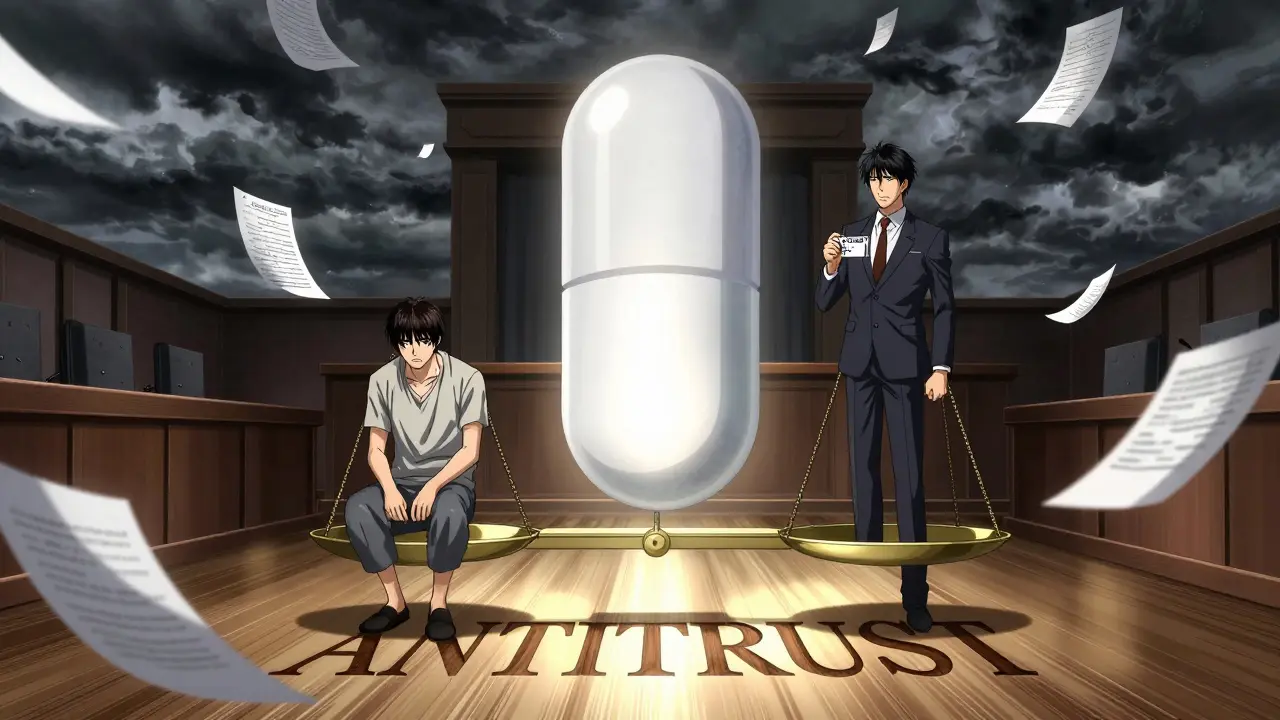
Every time you fill a prescription for a generic drug, you’re saving money-often hundreds of dollars compared to the brand-name version. But that savings didn’t happen by accident. It’s the result of a decades-long legal battle over how to keep drug markets competitive. Antitrust laws in the pharmaceutical industry aren’t just about big corporations fighting each other. They’re about whether you can afford your medicine next month.
How Generic Drugs Got Their Start
Before 1984, getting a generic drug to market was a mess. Companies had to repeat all the expensive clinical trials that the original drugmaker did, even though the active ingredient was identical. That made generics too costly to produce, and they barely existed. Then came the Hatch-Waxman Act a 1984 U.S. law that created a faster path for generic drugs to enter the market while protecting branded drug patents. It let generic manufacturers file an Abbreviated New Drug Application (ANDA), proving their product was bioequivalent to the brand, not that it worked the same in every patient. This cut development time and costs dramatically.The law also gave the first generic company to challenge a patent a 180-day exclusivity period. That was meant to be an incentive: be the first to fight, and you get a head start on sales. But over time, that incentive got twisted. Instead of speeding up competition, it became a tool for delay.
The Pay-for-Delay Trap
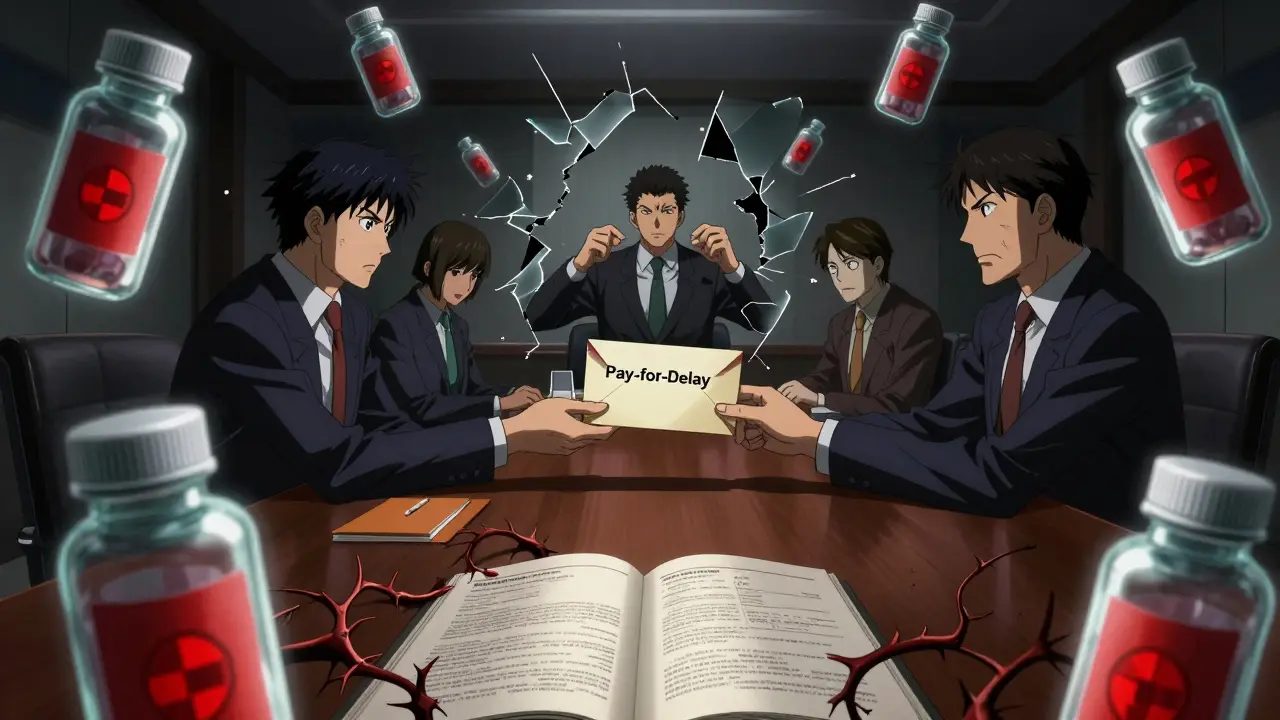
One of the biggest abuses in generic drug markets is called "pay-for-delay." It sounds like a contradiction: why would a brand-name company pay a generic maker to stay off the market? Because the math works for them. If a generic enters right after a patent expires, prices can drop 80% within months. But if that entry is delayed by even a few months, the brand keeps making millions in profits.The Federal Trade Commission (FTC) U.S. government agency responsible for enforcing antitrust laws and protecting consumers from unfair business practices has tracked over 18 of these deals since 2000, with settlements totaling more than $1.2 billion. In one notorious case, Gilead Sciences paid $246.8 million in 2023 to settle claims it paid a generic company to delay launching a cheaper version of its HIV drug. These aren’t just shady deals-they’re illegal under antitrust law, as confirmed by the Supreme Court in FTC v. Actavis (2013). The court ruled that reverse payments, if large and unexplained, can be anticompetitive.
Patent Games and the Orange Book
The Orange Book the FDA’s official list of approved drug products with therapeutic equivalence evaluations, used to track patents linked to branded drugs is supposed to be a public guide to which patents protect a drug. But companies have turned it into a weapon. Some list patents that have nothing to do with the actual drug formulation-like packaging methods or dosing schedules-to create fake barriers. Others file patents just before expiration, hoping to reset the clock on generic competition.In 2003, the FTC took action against Bristol-Myers Squibb for improperly listing patents on its blood thinner Plavix. The goal? To scare off generic makers and keep prices high. The FTC called it a "strategic abuse" of the regulatory system. Similar tactics have been used by companies like AstraZeneca, which introduced a slightly modified version of its heartburn drug Prilosec called Nexium just before the patent expired. This "product hopping" didn’t make the drug better-it just made it harder for generics to replace the original.
Sham Petitions and Regulatory Sabotage
Another tactic? Filing fake complaints with the FDA. These are called "sham citizen petitions." A company will submit a petition claiming a generic drug is unsafe or ineffective-often with no real scientific basis. The FDA then spends months reviewing it, delaying approval. The petition isn’t meant to protect patients. It’s meant to stall.In 2023, the FTC sued Teva Pharmaceuticals for using this exact strategy to block generic versions of Copaxone, a multiple sclerosis drug. Teva allegedly filed multiple petitions raising minor, irrelevant concerns, knowing the FDA would take time to respond. By the time the petitions were rejected, the window for generic entry had shrunk, and the company kept its profits intact.
Global Differences in Enforcement
The U.S. isn’t the only place where this fight is happening. In the European Union, regulators focus more on how companies manipulate national drug approval systems. Some firms withdraw marketing authorizations in certain countries just to block generics from entering those markets. Others make false claims about generics being less safe, spreading fear among doctors and patients.China, which only recently started cracking down hard, issued new Antitrust Guidelines for Pharmaceutical Sector China’s 2025 rules that identify five hardcore anti-competitive practices in the drug industry, including price fixing and algorithm-based collusion in January 2025. They now treat five practices as automatic violations: price fixing, limiting production, dividing markets, boycotting competitors, and blocking new technology. As of early 2025, six cases had already been penalized-five involved price fixing through text messages, apps, and even AI-driven pricing algorithms.
Meanwhile, the European Commission estimates that delays in generic entry cost European consumers €11.9 billion every year. That’s not a typo. It’s billions lost because of legal loopholes, not science.
Why This Matters to You
The numbers are personal. In 2012, Americans saved $217 billion by choosing generics instead of brand-name drugs. That’s $217 billion that went back into people’s wallets, not pharmaceutical boardrooms. But when competition is blocked, those savings vanish.A 2022 Kaiser Family Foundation survey found that 29% of U.S. adults skipped doses or didn’t fill prescriptions because they couldn’t afford them. Many of those cases involve drugs where generic entry was delayed by anticompetitive tactics. That’s not a market failure-it’s a human cost.
When a generic drug enters, prices don’t just drop a little. They collapse. One study found that the first generic reduces prices by at least 20% in a year. With five generics competing, the price drop hits 85%. That’s why companies fight so hard to keep them out.
What’s Changing Now?
The tide is turning, slowly. The FTC has ramped up enforcement. Courts are becoming more skeptical of "product hopping" and sham petitions. China’s 2025 guidelines are the most aggressive yet, using AI to monitor pricing collusion across online platforms. The European Union is pushing for faster generic approvals and transparency in patent listings.But the system is still rigged in places. Generic manufacturers still face legal threats, regulatory delays, and financial pressure. The Hatch-Waxman Act was meant to be a balance. Today, it often feels like the scales are tipped heavily toward the brands.
The next time you pick up a generic pill, ask yourself: was this drug allowed to reach you because of innovation-or because someone fought to make sure it could?
What is the Hatch-Waxman Act and how does it affect generic drugs?
The Hatch-Waxman Act of 1984 created a legal pathway for generic drug manufacturers to bring cheaper versions of brand-name drugs to market without repeating expensive clinical trials. It lets them prove bioequivalence through an Abbreviated New Drug Application (ANDA). In exchange, it gives branded drug companies patent protections. It also grants the first generic company to challenge a patent 180 days of exclusive market rights, which was meant to encourage competition-but has often been abused to delay it.
What are pay-for-delay agreements and why are they illegal?
Pay-for-delay agreements happen when a brand-name drug company pays a generic manufacturer to postpone launching its cheaper version. These deals keep prices high and reduce consumer savings. The U.S. Supreme Court ruled in 2013 (FTC v. Actavis) that such payments can violate antitrust laws if they are large and lack legitimate justification. They’re illegal because they’re not about patents-they’re about buying silence.
How do companies use the Orange Book to block generics?
The Orange Book lists patents associated with branded drugs. Companies sometimes list weak, irrelevant, or newly filed patents to create a barrier. Generic manufacturers must challenge every listed patent to enter the market. By adding extra patents, brand companies force generics into costly, time-consuming legal battles, delaying their entry even after the core patent expires.
What is product hopping and how does it hurt consumers?
Product hopping is when a drugmaker makes a minor change to a medication-like switching from a pill to a capsule or altering the dosage-right before the patent expires. They then market the new version as "improved," even if it offers no real clinical benefit. This tricks doctors and patients into switching, making it harder for generics to replace the original. The FTC has called this a tactic to evade competition.
How does China’s 2025 antitrust policy differ from the U.S. approach?
China’s 2025 Antitrust Guidelines for Pharmaceutical Sector treat five practices as automatic violations, including price fixing, output restrictions, and algorithm-based collusion. Unlike the U.S., which focuses on court cases and reverse payments, China uses AI to monitor pricing patterns across digital platforms and targets collusion through messaging apps. As of early 2025, six cases had already been penalized, showing a more proactive, tech-driven enforcement style.
Why do generic drugs cost so much less than brand-name drugs?
Generic drugs cost less because they don’t need to repeat the expensive clinical trials that brand-name drugs go through. They only need to prove they’re bioequivalent-meaning they work the same way in the body. The brand-name company already paid for the research and development. Generics just replicate the formula, which cuts their costs by 80-90%. That’s why prices drop sharply once multiple generics enter the market.
What You Can Do
You don’t need to be a lawyer to understand how this affects you. When you’re prescribed a brand-name drug, ask if there’s a generic. If your pharmacy says no, ask why. Is it because the patent hasn’t expired-or because someone is blocking it? Report suspicious delays to consumer advocacy groups or your state attorney general. Your voice matters more than you think.The fight over generic drugs isn’t about legal technicalities. It’s about whether you can afford to stay healthy. And right now, the system is still stacked against you. But it’s not hopeless. With more transparency, stronger enforcement, and public pressure, the balance can shift back.

Jay Ara
December 26, 2025 AT 14:07Michael Bond
December 26, 2025 AT 18:46Kuldipsinh Rathod
December 28, 2025 AT 08:11Ellie Stretshberry
December 28, 2025 AT 09:29Zina Constantin
December 30, 2025 AT 07:02Dan Alatepe
January 1, 2026 AT 01:07Angela Spagnolo
January 1, 2026 AT 23:11Sarah Holmes
January 3, 2026 AT 15:04